


Outdoor Christmas Wreath Hangers: Safe Options by Surface
By Rockdale Wreaths
Rockdale Wreaths Family
Your wreath has arrived, the bow is straight, and you're standing at the front door with a hook that looks sturdy enough. Before you hang it, check what that hook will rest on. A hanger that fits a solid wood door can pinch the seal on an insulated door, and a suction cup that held indoors can let go on cold glass.
We make fresh wreaths as a family business in Jonesport, Maine. Our advice on outdoor Christmas wreath hangers starts with the surface and the finished weight, not the appearance of the hook. We sell tombstone wreath hangers for a headstone. We don't sell house, window, or gate hardware, and a cemetery hanger isn't a door hanger.
Table of Contents
- Weigh the Wreath Before You Buy Hardware
- Which Hanger Fits Each Display Spot
- Why Wind and Cold Make Hooks Fail
- Match Hardware Finish to Coastal Weather
- How to Hang an Over-the-Door Wreath Safely
- Confirm Your Hanger Before You Hang the Wreath
Weigh the Wreath Before You Buy Hardware
A finished wreath can look modest on a 36-inch door and still load a hook heavily once lights, battery pack, bow, and pine cones are attached. Put the whole display on a kitchen scale before shopping. If it will not sit securely, set it on a tray and zero the tray first.
Weigh the wreath you'll hang; diameter tells you nothing about load. A small window wreath with lights may need only a light hook in a sheltered spot. A larger fresh balsam wreath carries more greenery and more decoration, so it needs a hook chosen for the finished weight, not the bare frame.
Wreath weight and door-size reference
| Item | Approximate weight | Hanging use | Hardware note |
|---|---|---|---|
| Decorated wreath | Weigh the finished piece | Front door, porch, office wall, or entryway | Include bow, cones, lights, and battery pack |
| Small window wreath with lights | Use its measured finished weight | Indoor or outdoor window | Use a light hook only where wind is low |
| Smaller fresh window wreath | Use its measured finished weight | Window | Choose hardware for the complete wreath |
| Larger fresh balsam wreath | Weigh the complete wreath | Door, porch, entryway, or covered outdoor space | Heavier greenery calls for a stronger hook |
| 36-inch door | Use the selected wreath's finished weight | Takes a 24 to 30 inch wreath | Match hook to wreath size and weight |
| 48-inch door | Use the selected wreath's finished weight | Takes a 30 to 36 inch wreath | Larger wreath needs a stronger hook |
| Grave wreath | Weigh the finished wreath | Headstone or grave | Use tombstone wreath hangers, not door hardware |
A larger wreath also presents more surface to wind, which makes the hook and the mounting point matter as much as the scale reading. A grave display is a separate job. Tombstone wreath hangers are sold for headstones and graves, so they should be chosen for that surface rather than treated as house hardware.
Allow for the finished display
Fresh greenery can become heavier after rain, so choose a working-load rating above the dry measurement. Country Living's wreath-hanging guidance also points out the importance of wet weight and protecting door finishes.
If you are deciding what to add yourself, plain green wreaths can help you plan the finished piece. For a broader look at the door itself, Breaking Glass Co.’s hardware picks for East Texas homes provide related door-hardware reading.
Which Hanger Fits Each Display Spot
Hanger by display spot
| Display spot | Hanger that holds | Why it works |
|---|---|---|
| Wood or metal house door | Over-the-door hanger rated for the finished weight | Rests over the top edge with no tape or holes |
| Insulated or uPVC door | Over-the-door hanger checked for seal clearance | Avoids pinching or bearing on the weather seal |
| Glass storm door or window | Mechanical hook on the door frame | Doesn't rely on cold-glass suction |
| Gate | Gate hardware sized for weight and swing | Gate movement needs suitable support; we don't sell it |
| Storefront glass | Frame-mounted hook fitted by an installer | Supports the display around wind and door traffic |
| Headstone | Tombstone wreath hanger | Fits the headstone and holds the wreath upright |
| Grave plot | Grave blanket laid flat on the plot | Lies flat on the plot, not hung |
For a house door, I'd start with a load-rated over-the-door hanger. This wreath-hanger guide lists over-door metal hooks with capacities up to 5 kg, about 11 lb, though that figure applies to particular hardware rather than every metal hook on the shelf.
Wood doors and metal doors often take the same style of hanger. The dimensions still differ. The top bend must match the actual door thickness, and the hook must sit securely when the door moves. A hanger bent for a thin metal door rides loose or binds on a thicker wood slab, and a loose hook is where most door displays start to fail.
Where the choice gets less straightforward
Insulated, composite, and uPVC doors need special attention at the top seal. Close the door slowly with the hanger in place. If the latch gets harder to pull or the seal compresses unevenly along the top edge, reject that fit instead of forcing the door shut.
For glass, put the support on a suitable frame rather than against the pane. A storefront installer should identify a fixing point that leaves the glazing untouched, clears the closer arm, and keeps the entrance unobstructed for foot traffic.
Gates need support that stays attached through their full swing, since a leaf that moves every day works a weak fixing loose faster than a door that mostly sits shut. If you move the display beside the entrance onto siding, identify that material first; SuperiorPRO's page to browse vinyl and fiber cement siding helps distinguish those surfaces, though it isn't a wreath-mount load specification.
Our Stainless Steel Tombstone Wreath Hanger belongs in the headstone category. We sell tombstone wreath hangers for cemetery headstones and graves, sized and shaped for that job.
Buy for the display spot: A house door needs a door hanger. A cemetery hanger isn't a substitute.
Why Wind and Cold Make Hooks Fail
A wreath hanging near its top acts like a lever. Wind pushes across its circular face while the upper attachment carries the turning force. Even a light wreath can twist a thin hook or work an attachment loose when it swings away from the door.
An application-specific wreath-mounting explanation gives the example of a 16-inch, 2.5-pound wreath producing more than 7 foot-pounds of torque in 20-mph wind. That figure depends on the setup; it isn't a universal rating for every wreath, doorway, or gust.
The diagram shows why the distance between the wreath and its support matters.
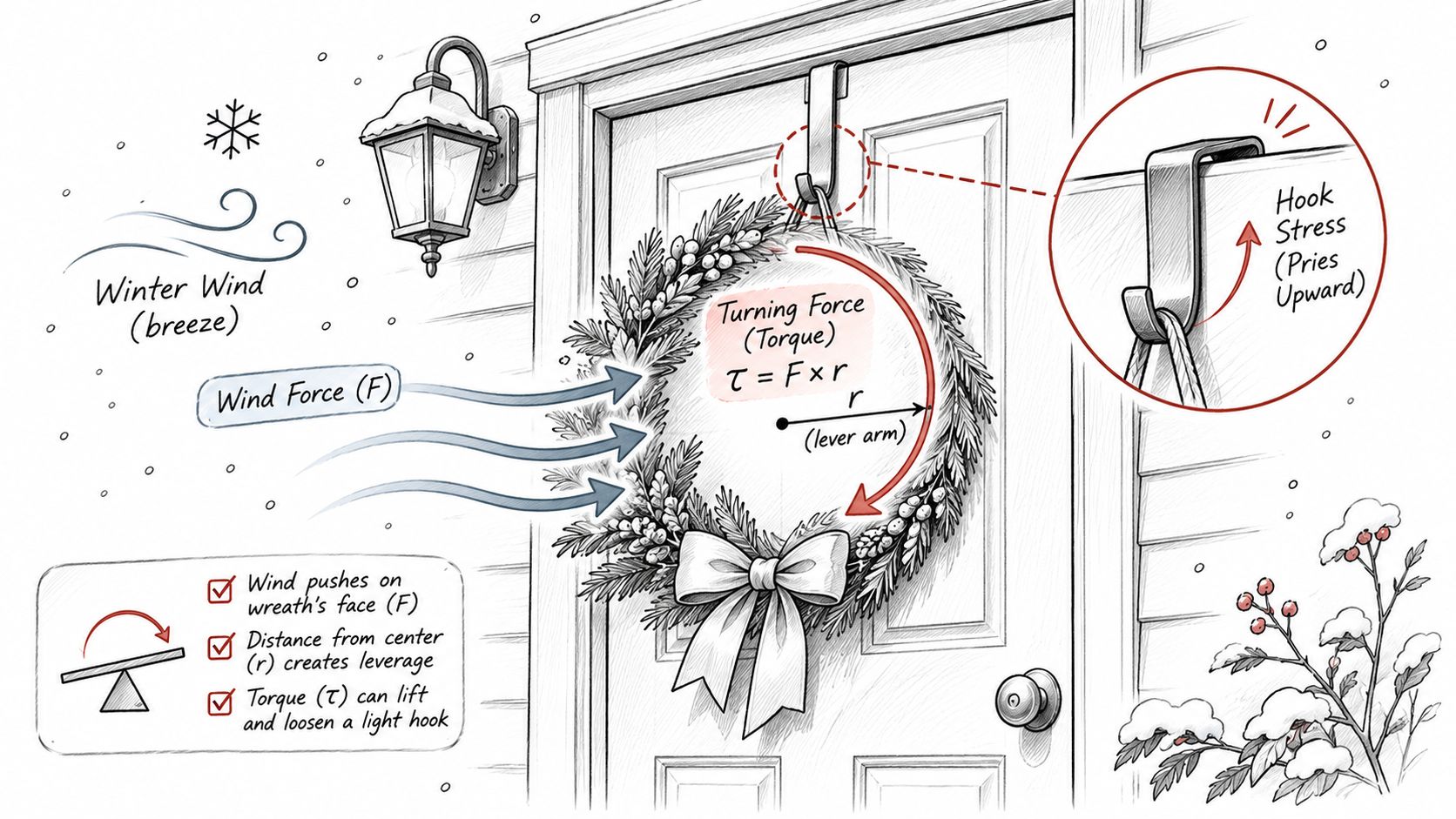
Static capacity isn't wind resistance. A hanger's stated load may describe a steady downward pull under suitable mounting conditions. It doesn't necessarily describe repeated sideways loading, twisting, or a fastener being pulled outward.
For an exposed entrance, I would choose a working-load rating several times the measured wreath weight, keep the wreath close to the door, and add a discreet lower stabilizing tie. That tie needs its own suitable attachment point. Don't solve upper-hook movement by sticking tape to the lower door panel.
Cold glass and damaged finishes
Cold glass presents a separate problem. Storables' explanation of suction-cup adhesion describes how temperature changes and contracting glass can disrupt the seal. Don't use a suction cup on cold window glass for a wreath.
Tape isn't the answer either. It can release during the display period or pull paint and finish away when removed. If tape is already attached, follow its removal directions rather than yanking it off in the cold.
Hanging failures, causes and fixes
| Symptom | Likely cause | Fix |
|---|---|---|
| Suction cup slides or drops off glass | Cold glass contracts and breaks the seal | Use a mechanical hook on the door frame |
| Tape pulls paint or finish off the door | Adhesive bonds to the finish and tears it on removal | Remove carefully and use a door hanger made for the surface |
| Wreath swings and rubs the door | Wind leverage on an unsupported hook | Keep the wreath close and add a lower tie |
| Hook bends or pulls out after a storm | Light hook or loose fastener under wind load | Replace with stronger hardware and inspect its mounting |
| Wreath sags after rain | Greenery is heavier when wet | Choose a hanger with capacity above the dry weight |
After a major storm, inspect the hook's bend, fasteners, stabilizing tie, and the finish behind the wreath. Look for adhesive movement on any existing mount, and take the wreath down while correcting a loose support.
When choosing a display location, our outdoor Christmas wreath guidance can help you consider the wreath alongside the exposure. A sheltered position is preferable to asking a stronger hook to solve every wind problem.
Match Hardware Finish to Coastal Weather
Start with the metal, then check the shape and load. Jonesport's salty, damp air makes metal choice worth checking. For exposed coastal or humid locations, 304 stainless steel generally offers better corrosion resistance than powder-coated steel. Galvanized steel is another stronger choice for wet outdoor exposure.
Metal type matters, but thickness and capacity decide fit. The hanger specifications in this industrial hardware catalog include a stainless over-door design limited to doors no thicker than 0.79 inch, with a rating of 5 pounds per hook. A corrosion-resistant hanger can still be the wrong shape or capacity for your door. That matters once bows, pinecones, lights, and retained moisture add weight.
Check fit as carefully as finish
- Door thickness: Measure the top edge and compare it with the hanger's stated range. Don't spread a narrow hanger by hand to make it fit.
- Seal clearance: Confirm that the metal clears the weather stripping without crushing it.
- Exposure: Prefer stainless or galvanized hardware for exposed wet conditions. Reserve powder-coated steel for more sheltered positions, and inspect chips in the coating.
- Working load: Compare capacity with the completed wreath, allowing for retained moisture.
A sound finish won't correct a hanger that rocks on the door or presses into a fragile panel.
Use a protective rubber or polymer interface where metal could scratch the surface, without blocking drainage paths. That is a small detail, but it keeps the finish from being rubbed raw by a hook that shifts. On gate displays, the hardware choice is closer to a fence decision than a door decision. AlliedFenceAndGate.com™ discusses salt-resistant hardware for coastal gates, which is useful when the wreath is fixed to metal rather than resting over a door.
Door and window hardware still needs its own checks. The surface, clearance, exposure, and load are what decide whether the hanger belongs there.
How to Hang an Over-the-Door Wreath Safely
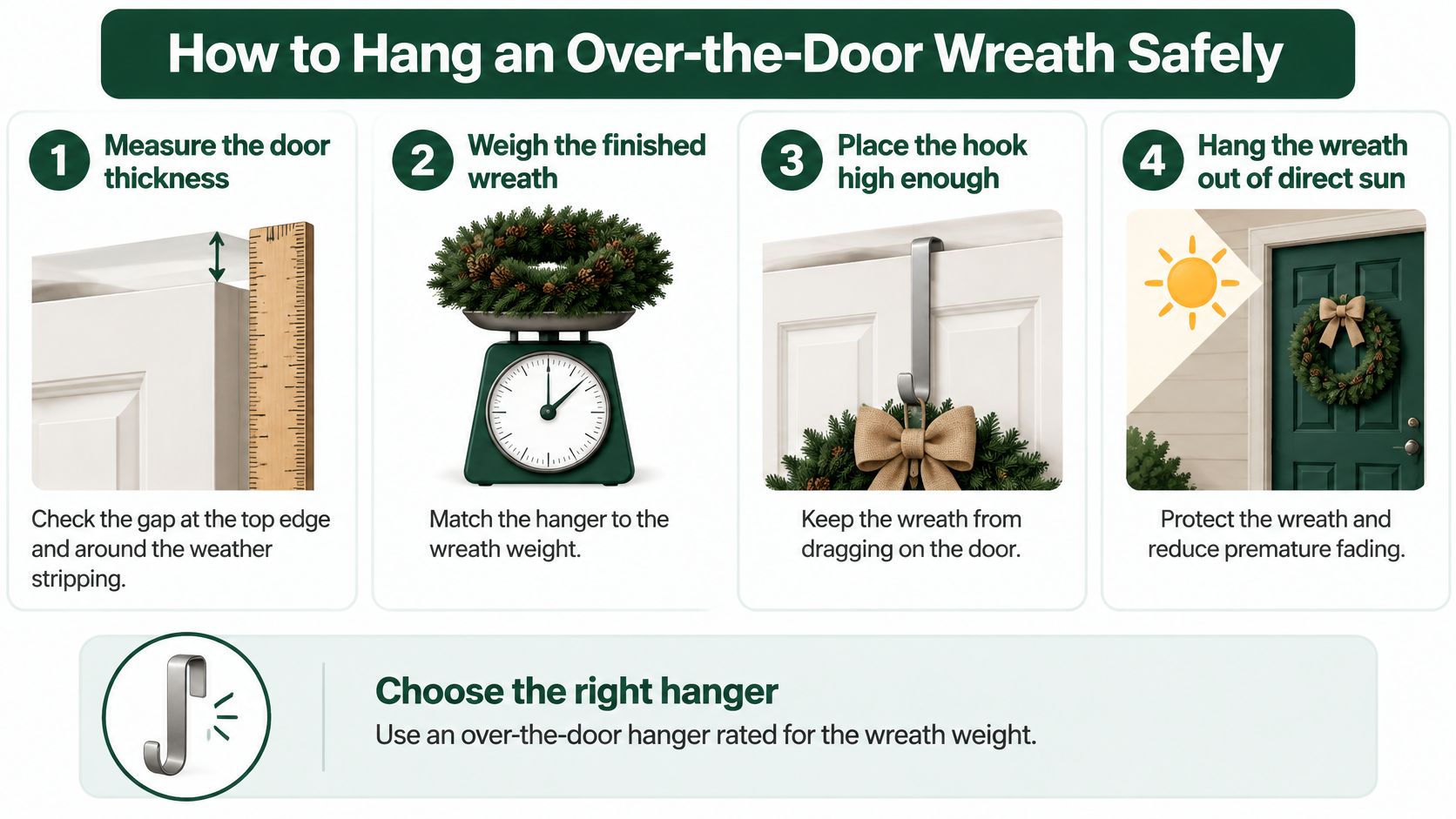
Lay out a tape measure, scale, suitable protective pads, and the selected hanger before starting. Work with the door open and the threshold clear so you can check the fit without balancing the wreath in one hand.
This visual summarizes the main checks before the full installation.
Fit and hang the wreath
-
Measure the door thickness and clearance. Measure at the top edge where the hanger will sit, then inspect the gap above it and around the weather stripping. Try the empty hanger first; if the door catches, don't force it closed.
-
Weigh the finished wreath. Include bows, pine cones, lights, and their power pack, then select a hanger rated above that measurement with an allowance for exposure. Keep the scale reading with the hardware information so you aren't guessing when changing decorations.
-
Open the box the day it arrives. Check the wreath frame, the hanger, and the receiving hook for damage before putting them under load. Hang the fresh wreath out of direct sun rather than leaving it packed while you sort out unsuitable hardware.
-
Place the hook high enough. Set the over-door hanger securely over the top, or use a properly fitted mechanical hook in a suitable door or frame, so the wreath doesn't drag on the threshold. The 30 inch Maine balsam needs a stronger hook than a small window wreath, and its lower edge needs clearance through the whole door swing.
-
Protect the contact points. Put a rubber or polymer pad wherever metal could rub painted, composite, or uPVC surfaces, provided the pad doesn't make the top fit too tight. Check the back of the wreath too, because exposed frame wire can mark the door even when the hanger is padded.
-
Test normal door use. Open and close the door several times, checking swing, latch engagement, seal compression, and clearance around the wreath. If you have a second door, use our guidance on hanging a wreath on a storm door to consider the space between the doors before settling on placement.
-
Check after the first wind and rain. Support the wreath from underneath while inspecting the hook and its contact points. Correct any new movement, sagging, or rubbing before leaving the display unattended again.
Check access and lighting
The installation video provides another visual reference while you assess your own entrance.
Keep the handle, lock, doorbell, and viewing area usable. A wreath that fits while the door is shut can still catch a railing, closer, or adjacent wall when someone opens it fully.
For lighted wreaths, secure the battery pack to the wreath frame rather than leaving it to swing by its wire. Don't run a cord across a door seal or place a connection where closing the door can crush it.
Before stepping up: Bring the work within comfortable reach whenever possible. Don't stand on a chair or stretch sideways to finish the job.
Use a stable step stool rather than a ladder when the height permits, on a firm, level, dry surface. The Consumer Product Safety Commission's holiday-decorating safety guidance advises using lights certified for outdoor use and connecting them only to a ground-fault circuit-interrupter-protected receptacle or portable GFCI. Use outdoor-rated electrical components throughout and keep connections protected from moisture.
Confirm Your Hanger Before You Hang the Wreath
A hanger is only right in relation to the surface carrying it and the finished weight hanging from it. By this point, those two should already be settled. What remains is the final fit check in the exact display spot.
Start with exposure. I would treat it as the deciding factor when two hangers otherwise look equally suitable. A sheltered entry puts less strain on a hook than an open porch, gate, or grave, where wind can lift or twist the wreath. In an exposed spot, choose the hanger that seats securely on that surface rather than using extra wire to compensate for a loose fit.
Then test movement. Open and close a door or gate through its full swing with the wreath at final height. On a fixed surface, use a light push. The wreath should stay seated without rocking, tapping, scraping, or pulling the hook out of position. Correct movement now, before wind adds force.
Memorial pieces need the same surface-first judgment. A tombstone wreath hanger serves a headstone or grave, so it is not a substitute for door hardware. Rockdale Wreaths sells tombstone wreath hangers for headstones and graves. We don't sell house-door, window, or gate hardware; those locations need hardware selected for their own surface and load.
Confirm exposure first, test movement second, and leave the display only when it stays put.
We make fresh Christmas wreaths and seasonal balsam decorations in Jonesport, and offer tombstone wreath hangers for headstones and grave blankets that lay on the plot. Visit Rockdale Wreaths to choose your wreath or memorial greenery, then match the display with hardware made for its weight and surface.

