


Kissing Ball Wreath: What It Is and Where to Hang It
By Rockdale Wreaths
Rockdale Wreaths Family
Why do so many holiday guides treat a kissing ball wreath as just another version of a front-door wreath when the two shapes hang in completely different ways? That mix-up sends people home with the wrong format for their porch, the wrong hardware for the job, and no plan for how fast suspended indoor greenery dries into a fire risk. Shape, hanging point, and care separate the two pieces, and the sections ahead take each in turn. One more thing before the details: here in Jonesport we craft fresh Maine balsam wreaths, including decorated rings like the Rockdale Original, and kissing balls are one thing this shop does not make.
Table of Contents
- What a Kissing Ball Is and How It Differs From a Wreath
- Where a Kissing Ball Hangs in a Home
- Keeping Hanging Greenery Safe Indoors
- A Short History of the Kissing Ball
- Matching a Balsam Piece to Your Display Spot
- Order the Right Balsam Piece for Your Spot
What a Kissing Ball Is and How It Differs From a Wreath
Put a kissing ball next to a traditional wreath on a workbench, and the structural difference shows right away. According to Recollections' overview of mistletoe traditions, historical accounts describe kissing balls as "medium to large-sized spheres" built from evergreen branches, sometimes with mistletoe tucked at the center, while a traditional wreath uses a circular frame covered in greenery. One occupies three-dimensional space from a single overhead point. The other holds an open middle and rests flat against a door, wall, or pane of glass.
That geometry changes how you see the piece. A kissing ball fills the air below its hanging cord so you view foliage from every angle as you walk past or stand beneath it. A traditional wreath presents a clean ring silhouette, showing one front face against a solid door or both faces when hung on glass.
| Form | Shape | Open center | Viewed from |
|---|---|---|---|
| Kissing ball | Sphere of greenery | No, the ball is filled | Every side as it hangs |
| Traditional wreath | Ring of greenery | Yes | Front face, or both faces if double-sided |
Why Shared Evergreen Material Causes Confusion
Both decorations use winter boughs, ribbons, and seasonal accents, which tricks shoppers into thinking the names are interchangeable. Shared foliage says nothing about structure. Even a wreath finished with decorative bows, pinecones, and natural accents on both faces still hangs vertically against a surface, because the frame underneath is a ring with an open center rather than a filled core built for suspension.
At Rockdale Wreaths, every piece we craft, from the Rockdale Original to the Rockdale Classic and Rockdale Deluxe, is a fresh Maine balsam ring finished in the shop. We make no spherical kissing ball, no mistletoe-centered orb, and no suspended greenery ball of any size. Whenever you shop for winter greenery, check the underlying frame and product form first instead of buying on foliage type alone. If the piece needs open air around every side, it is a ball. If it sits flat against a door, window, or wall, it is a ring.
Where a Kissing Ball Hangs in a Home
What does a sphere do that a door wreath cannot? It needs air around it. Because a kissing ball has no flat back, it belongs overhead rather than pressed against siding, trim, or glass. As A Pumpkin and a Princess's guide to Christmas kissing balls points out, people commonly hang them in entryways, from indoor ceilings, on front porches, and from light fixtures, just as older kissing boughs hung from doorways and chandeliers. Those open spots give the rounded silhouette room to be seen from every side as visitors come and go.
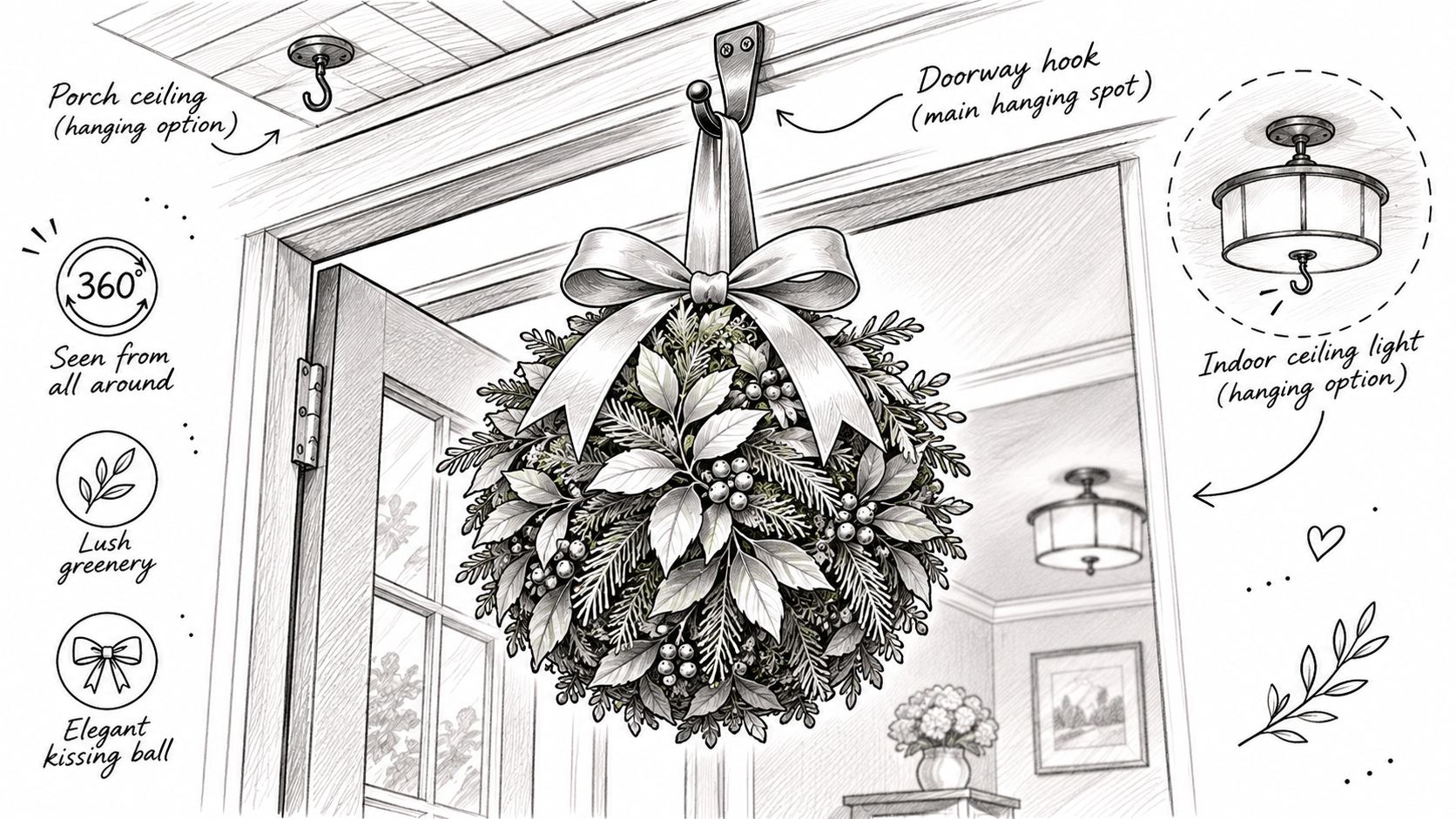
A porch ceiling or open hallway also changes the load. A door hook mainly holds a flat piece close to the surface. A suspended ball puts the full weight on one hanging point: core, evergreen cuttings, cones, ribbons, and any moisture still held in fresh foliage. If the greenery is unevenly spaced or the loop sits off center, the sphere tilts or spins each time a door opens and air moves through the hall.
Checking Clearance and Hanging Hardware
Measure the room before buying hardware. We do not build or list a kissing ball, so there is no Rockdale size, ribbon length, or hanging kit to quote for one. Doorway heights, porch beams, and foyer ceilings vary, so the tape measure sets the drop length.
Use one procedure for the whole job:
- Pick the overhead spot. Stand under the doorway, porch beam, or ceiling joist and confirm people will not duck to pass it. Check that the top of the sphere clears the door casing and that the bottom sits well above head height.
- Check the swing path. Open the door all the way. Look for contact with the casing, nearby trim, or ribbon, then allow room for the ball to move slightly when doors and people pass.
- Measure the drop. Run a tape measure from the ceiling or header down to your target clearance height, then subtract the sphere's diameter to find the ribbon or wire length.
- Set the anchor. Mark the point directly above the desired center line. Use a screw hook, swag hook, ceiling anchor, or proper toggle anchor rated for the full wet weight of fresh boughs, not a light adhesive tab meant for paper garlands. Drive it into solid wood where possible, then test it with a firm tug.
- Hang and inspect from every angle. Suspend the ball, open and close nearby doors, and confirm it hangs straight. Step back and walk past it to catch any tilt that is hard to see from directly underneath.
- Keep heat away. Give recessed lights, chandelier bulbs, vents, and radiators generous clearance so warm air does not dry the foliage from below or above.
This same surface check helps when planning greenery across several rooms. If you are working to get your home holiday-ready, match the form to the spot. A wreath belongs on a door, window, office wall, or entryway. A swag follows a mantel or railing. A centerpiece belongs on a table. Rockdale centerpieces are finished with decorative bows, pinecones, and other natural accents, while our rings are made with fresh greenery and classic holiday detail for doors, homes, offices, gifts, businesses, or graves. You can also explore creative ways to display indoor wreaths when you want fresh balsam inside without drilling a ceiling hook.
For a visual walkthrough of how overhead evergreen spheres come together and balance on a ribbon, this short video shows the assembly process in motion.
Keeping Hanging Greenery Safe Indoors
Many holiday guides treat fresh greenery as harmless because it feels cool and smells green out of the box. That assumption puts homes at risk. According to University of Missouri Extension guidance on holiday greenery, cut greenery brought indoors early in the season can become very dry by New Year's Day and turn into a fire hazard. The same extension report notes even stricter University of Georgia advice recommending that indoor holiday greenery be replaced every week, because fresh boughs remain flammable as moisture leaves the stems.
Fresh does not mean fireproof, and spritzing a hanging ball with a spray bottle won't make dried needles safe. Misting wets the surface for a few minutes while the inner stems keep losing water into warm indoor air. Starting with crisp, newly cut boughs, storing them cool before display, keeping stems in water where the construction allows, and swapping dry greenery out on schedule are what control risk.
This safety checklist breaks down the core hazards and habits for any hanging winter boughs brought inside.
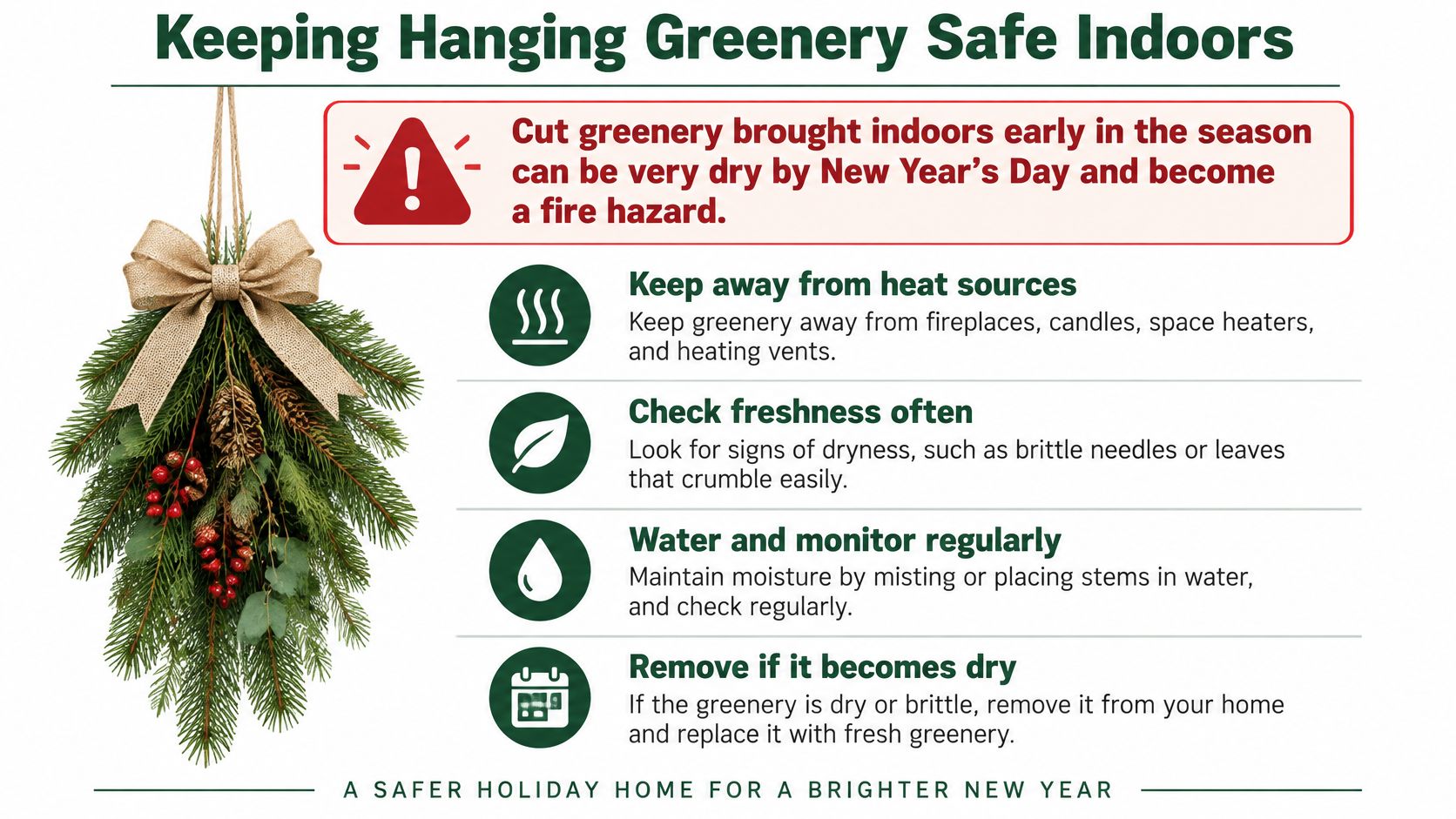
| Check | Reference guidance | What to do |
|---|---|---|
| Replacement interval | Every week, per University of Georgia guidance | Swap the ball on a weekly schedule |
| Early-cut greenery | Can be very dry by New Year's Day, per University of Missouri guidance | Start with fresh material and keep stems in water where possible |
| Heat exposure | Keep away from fireplaces, radiators, vents and heat appliances | Confirm clearance before hanging |
| Brittleness and needle loss | Dried greenery is a fire hazard | Bend a sprig to test, and replace the ball if it snaps or sheds |
| Misting | Not a complete safety solution | Rely on fresh material and replacement instead |
Indoor Heat, Freezing Porches, and Weekly Inspections
A suspended kissing ball sits high in the room where warm air collects, which dries it faster than greenery placed low or outside. Keep it well clear of fireplaces, baseboard radiators, forced-air vents, and heat-producing appliances. Don't hang fresh evergreens directly above a dining table with lit candles or right below a chandelier with hot incandescent bulbs.
Outdoor balls hung on a covered porch in freezing weather behave differently from indoor ones. Cold air slows moisture loss so outdoor balsam holds its flexibility much longer, though harsh wind and direct winter sun can still desiccate exposed tips. Indoors, inspect your greenery at least once a week by gently bending a small sprig between your fingers. If the stem snaps cleanly instead of flexing, or if needles rain onto the floor when you tap the ribbon, take the piece down right away. For broader seasonal upkeep across rings and swags, our guide to wreath care and maintenance covers cool storage and handling steps that help cut boughs last outdoors.
Real Mistletoe Precautions and Responsible Disposal
If a kissing ball uses real North American mistletoe (Phoradendron leucarpum), botanical safety matters just as much as fire prevention. As Penn State Extension explains in its guide to mistletoe and holly, white mistletoe berries contain toxic compounds that can cause gastrointestinal distress if swallowed, and berries can shake loose during shipping or door slams. While Penn State notes University of Illinois Extension findings that one to three American mistletoe berries or one to two leaves are unlikely to cause serious toxicity, the clear rule is to keep real mistletoe well out of reach of children and pets, away from food tables, or use synthetic mistletoe in offices, storefronts, and hospitality spaces.
Once indoor boughs turn brittle, take them down immediately and strip off wire, floral foam, plastic berries, and bows before disposal.
Reuse matters to a lot of households now. In a Thumbtack survey cited by Martha Stewart and highlighted by the National Christmas Tree Association's 2025 holiday decor trends, more than half of respondents reuse holiday decor year after year, and 43% consider sustainability before buying new decorations. Saving clean ribbons, cones, and metal frames for next year while sending stripped natural greenery to local municipal composting keeps holiday waste low without leaving hazardous dried boughs hanging indoors.
A Short History of the Kissing Ball
Round greenery hung overhead for centuries before anyone kissed beneath it. According to the Elisabeth C. Miller Library's overview of kissing ball history, medieval Europeans crafted suspended greenery called "holy boughs" that sometimes held a figurine of the infant Jesus at the center. As Home Garden Joy's historical look at Christmas kissing balls adds, early villagers tied evergreen branches into rough spherical shapes to bring winter green indoors long before courting customs entered the picture.
During the Victorian period, hanging spheres came back into fashion in a more secular style, dressed with evergreens, ribbons, ornaments, and sometimes mistletoe around a spherical frame. The round shape solved a simple room-layout problem: unlike a flat door wreath, a ball could hang from a ceiling, doorway, or central parlor beam so guests could gather underneath from every side. Shape decided the hanging point then, and it still does now.
How Mistletoe Joined the Tradition
Mistletoe gradually became the signature plant tied to love, fertility, and holiday kissing, though the Miller Library FAQ notes three distinct dates in the early record, and the sources behind them do not fully agree:
- 16th-century England: the earliest documented example of kissing under mistletoe.
- 1784 comic opera: the production "Two to One" stands as a specific early English record of the custom.
- 1784 English poem: identified as the first known written reference to kissing beneath mistletoe.
Even with those varying dates, the timeline is clear: hanging winter greenery overhead came centuries before the late-18th-century kissing custom, and the Victorian kissing ball merged the two. If you're curious how circular rings evolved on their own path, our look at the origin of the wreath traces that separate story.
Rockdale's place in this history is the ring, not the sphere. We do not make kissing balls or any hanging sphere; what we build in Jonesport is the flat handcrafted wreath of fresh Maine balsam, pine cones, and natural greenery, sized to hang on a front door, porch, office wall, or entryway without extra setup. The sphere belongs to a ceiling hook. The ring belongs to a door. Knowing which half of the tradition you want is the first step to hanging it safely.
Matching a Balsam Piece to Your Display Spot
Historical kissing boughs were not built one single way. An Encyclopedia entry on the kissing bough describes greenery wound around a circular wire hoop and also notes spheres formed by crossing one hoop inside another for doorway, ceiling, and chandelier display. That structural overlap helps explain why shoppers still type “kissing ball wreath” when hunting for fresh winter evergreens.
The practical difference is shape and hanging point. A wreath is a ring made for a door, window, wall, or entryway. A kissing ball is a sphere meant to hang overhead, usually where people can gather beneath it. Rockdale makes fresh Maine balsam rings and balsam decorations. We do not make hanging spheres.
| Display spot | Format | Rockdale product |
|---|---|---|
| Front door or porch entry | Door wreath | Finished wreath designs, including the Rockdale Original, Rockdale Classic, Rockdale Deluxe, Classic Lights, and White Lights |
| Window | Small window wreath | Smaller fresh window wreath, lighted or unlighted |
| Table | Not a Rockdale format | Source a centerpiece elsewhere |
| Mantel or linear surface | Balsam decoration | Christmas Swag |
| Custom spot or design | Custom wreath | Create Your Own, finished with bows, pinecones, and natural accents |
| Hanging sphere from a ceiling | Kissing ball | Not made by Rockdale |
Doors, Windows, and Flat Surfaces
Door wreaths are the straightforward fit for front doors, porches, entryways, office entrances, storefronts, gates, barns, and covered outdoor spaces. Each Rockdale wreath is made with fresh greenery and classic holiday detail, and it can hang at home, at the office, or on a front door throughout the Christmas season. Measure the trim, storm-door handle, lock hardware, and outer frame so the ring clears moving parts.
Windows need smaller proportions so the greenery frames the glass without taking over the sash. Smaller fresh window wreaths work indoors or outdoors, with lighted options available when you want the greenery visible after dark. A lighted piece adds a wiring consideration, so check the nearest power source before choosing that route.
Tables call for a low arrangement that leaves room for serving dishes. Rockdale does not make a table centerpiece, so that piece belongs with a maker who specializes in table greenery. Along a mantel, railing, or narrow architectural line, a Christmas Swag follows the surface better than a circle. Balsam decorations include sprays, swags, and crosses, including the Christmas Swag and the Candy Cane Wreath.
Custom Rings and Ceiling Spheres
Some spots need a particular mix of bows, pinecones, and natural accents. Finished wreath designs are ready to hang, while Create Your Own is the customizer for a personalized Christmas wreath built to a parts list. Each custom wreath is finished in the shop with decorative bows, pinecones, and other natural accents.
A larger wreath, or one with more dressing, is priced on its own product page. That matters when a doorway has extra width or when the setting calls for a more decorated piece. The 30-inch Maine Balsam is the large wreath option.
For an overhead sphere, choose a florist or craft maker who builds kissing balls. Rockdale does not build spheres and does not assign a size or ribbon length to a product we do not make. That boundary keeps the display plan honest: rings, swags, sprays, and crosses fit the balsam work we do, while the hanging sphere belongs to another maker.
Order the Right Balsam Piece for Your Spot
The wrong balsam order almost always starts the same way: a photo of a wreath you liked, bought before anyone measured the door it was meant for. We always measure the spot first, write down the format, and only then choose the greenery style.
- Name your exact spot. Write down whether you're decorating a front door, porch, window, dining table, mantel, or open ceiling.
- Measure clearance before picking a diameter. Check that a door or window piece clears the trim, outer frame, storm-door handle, and lock hardware so nothing scrapes when the door shuts. A ring that looks perfect on screen can still wedge against a storm door that sits close to the entry door behind it.
- Account for heat near the display point. Fresh greenery dries out faster near radiators, heating vents, fireplaces, and candles, and dry balsam close to an open flame is a real hazard. If your chosen spot sits near a heat source, either move the greenery or plan to keep it well clear and misted.
- Decide how the piece will hang. Rings hang flat against a surface from a single point on the frame. A ceiling or beam calls for a sphere that suspends in open space, and that piece comes from a kissing-ball maker rather than a wreath shop. Confirm which of the two your spot needs before ordering anything.
- Choose finished or custom rings. We offer finished wreath designs ready to hang straight from the box, while Create Your Own is our customizer for a personalized or custom Christmas wreath built to a parts list.
Double-Check Before You Place Your Order
Before you click buy, jot down two lines on a notepad: the exact spot you measured and the matching product name from its row. That two-second habit stops a large door ring from showing up for a narrow basement window, or a table centerpiece from getting ordered when you wanted a wall piece. When the format fits the space, fresh Maine balsam settles right in and carries the house smoothly through the season.
On our family farm in Jonesport, Maine, we craft fresh balsam door wreaths, smaller window wreaths, centerpieces, swags, and custom rings built to order and packed right here before shipping across the 48 contiguous states. Whether you need a Rockdale Original for your front door, a balsam centerpiece for your table, or a custom ring built through Create Your Own, you can match every spot in your home to the right balsam format. Browse our seasonal designs and place your order at Rockdale Wreaths.

