


Origin of the Wreath: From Greek Crowns to Advent
By Rockdale Wreaths
Rockdale Wreaths Family
Origin of the Wreath: From Greek Crowns to Advent
Check the setting before choosing
A practical test for historical claims
Claims that need qualification
Applying the distinction today
Living leaves and lasting gold
An athlete wins at Olympia and receives a crown of wild olive leaves. More than two millennia later, an evergreen wreath hangs on a Christmas door. How did a crown become a decoration?
The answer is not one invention or an unbroken Christmas tradition. The origin of the wreath lies in ancient ceremonial plant crowns, while the history of Christmas wreaths also involves winter greenery and, separately, the Advent candle ring. Their shared shape is a useful starting point, not proof that they always meant the same thing.
Table of Contents
- A Crown Before a Decoration
- Wreath Origins Across Eras at a Glance
- Ancient Greek Crowns and What Each Plant Meant
- How Rome Turned the Crown Into Public Ceremony
- Wreaths in Burial and Remembrance
- From Crown to Candle Ring
- From Winter Greenery to the Christmas Door
- Separating Myth From the Evidence
- Choosing a Wreath With Its History in Mind
A Crown Before a Decoration
At Olympia, the olive crown marked a victor in a public ceremony. It was worn, not hung on a door. Its plant material identified a particular honor, and its meaning depended on the occasion.
Historical distinction: A circular arrangement of greenery can serve as an award, a memorial, a calendar of waiting, or a seasonal welcome. Similar form does not establish a direct line of descent.
That distinction guides the story. Greek and Roman crowns made honor visible. Burial wreaths belonged to mourning. Wichern's candle ring helped children count toward Christmas. Household evergreens later helped shape the Christmas door wreath. To understand any one of them, ask who used it, where it was placed, and what it communicated.
Wreath Origins Across Eras at a Glance
| Era | Setting | Form | Purpose |
|---|---|---|---|
| Ancient Greece | Panhellenic games | Olive, laurel, celery, or pine crowns | Recognition of victors |
| Ancient Greece | Ceremonies and burials | Plant and gold wreaths | Honor, devotion, and commemoration, depending on context |
| Roman period | Public honors and seasonal customs | Honor crowns and garlands | Distinct civic and social uses |
| 19th-century Germany | Children's Advent observance | Candle-bearing wheel, later adapted | Counting the days or Sundays before Christmas |
| Later household Christmas decorating | Home and doorway | Evergreen ring | Seasonal decoration and welcome |
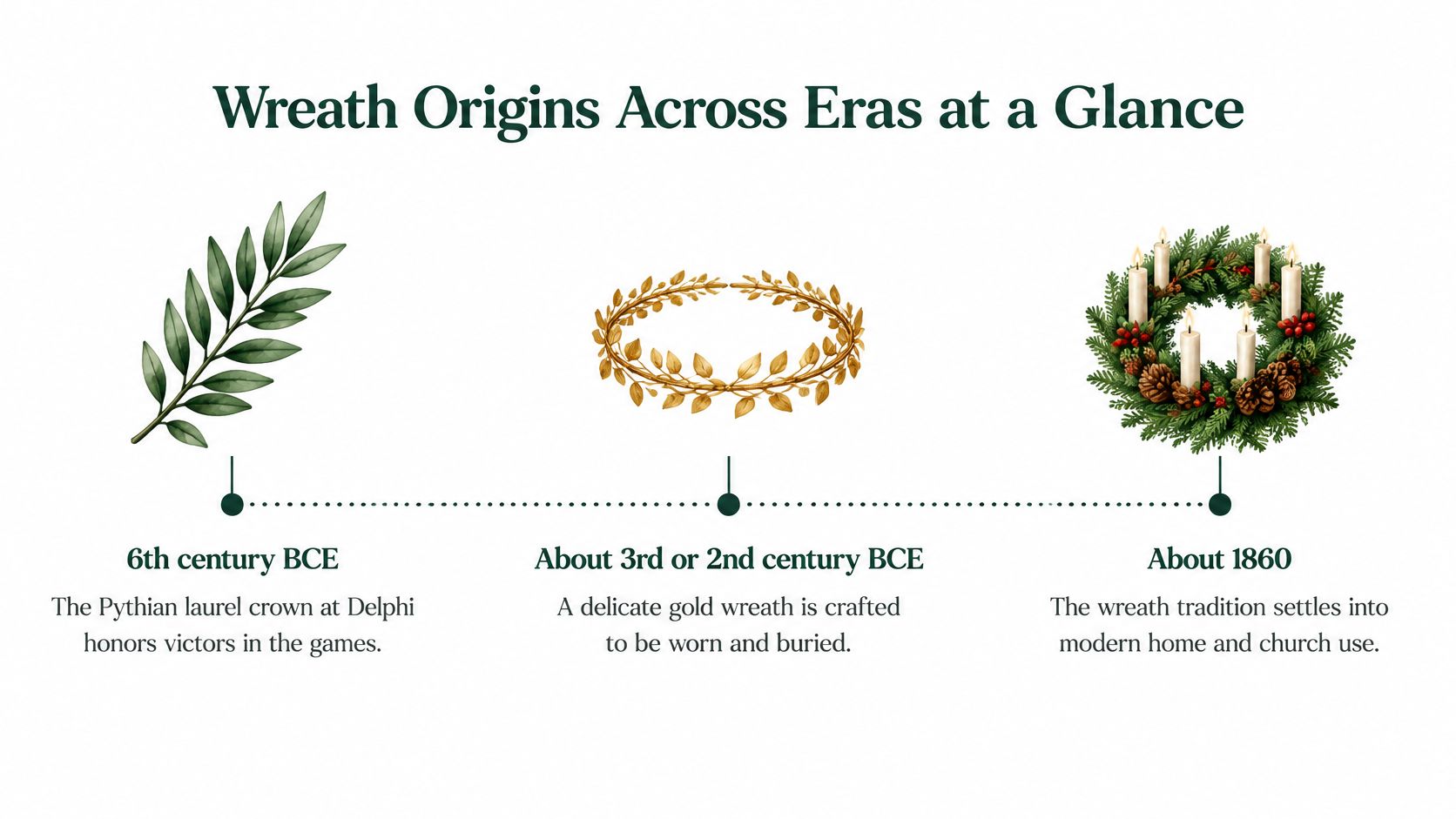
The rows are not a relay in which each culture handed one unchanged custom to the next. Ancient victory and burial wreaths already served different purposes. Nor does the record identify a precise first Christmas door wreath.
Ancient Greek Crowns and What Each Plant Meant
The Greek laurel crown was one prize among several. As Greek Reporter's account of ancient wreaths describes, winners at the major games received plants associated with their particular competitions. The ancient Olympic Games took place at Olympia in honor of Zeus, with a four-year cycle.
| Games | Winner's plant | Setting |
|---|---|---|
| Olympic | Wild olive, or kotinos | Olympia, honoring Zeus |
| Pythian | Laurel | Delphi, honoring Apollo |
| Nemean | Wild celery | Nemea |
| Isthmian | Pine | Isthmian games |
A runner at Olympia and a competitor at Delphi could both wear crowns, but their plants identified different honors. Laurel was never the universal ancient wreath material.
Living leaves and lasting gold
Greek craftspeople also fashioned wreaths from gold, reproducing leaves in a lasting material. A surviving Greek gold wreath at the Brooklyn Museum illustrates this ceremonial form. Gold wreaths could be worn, offered, or placed in burials; their survival does not demonstrate an ancestral Christmas door decoration.
The point is context, not material alone. A wreath made from fresh foliage and one made from gold might resemble each other while serving different ceremonial needs.
How Rome Turned the Crown Into Public Ceremony
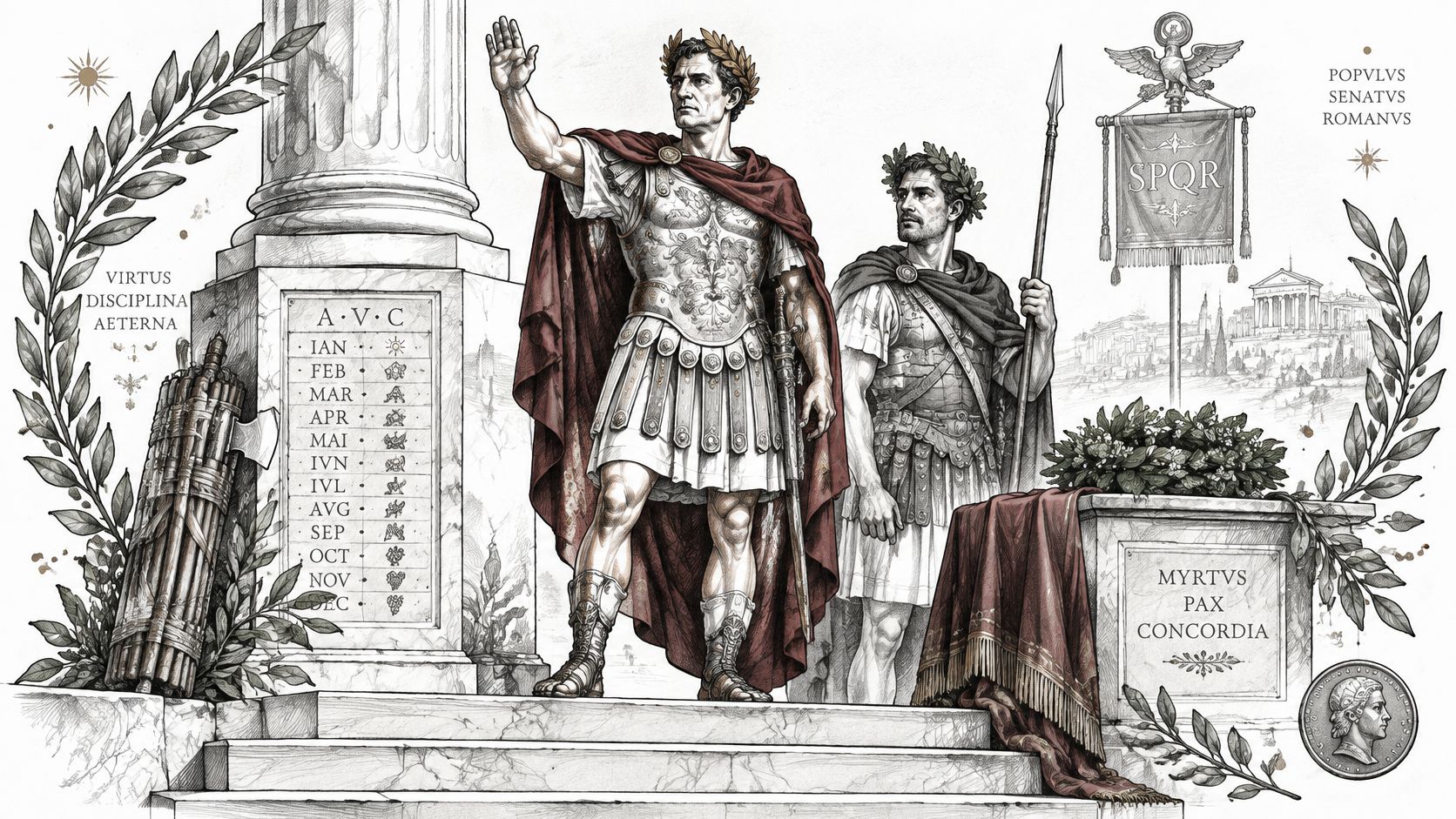
Roman crowns could make a public honor visible. English Heritage's history of Christmas greenery notes the prestigious grass crown, or corona obsidionalis, associated with freeing a besieged army. Ordinary grass could carry extraordinary honor because the achievement, not the cost of the material, mattered.
Honor and annual renewal
Award crowns and seasonal garlands did different jobs:
- Honor crowns identified a person recognized for service or achievement.
- Seasonal garlands belonged to recurring social occasions. Accounts of Roman New Year customs, or the Kalends, associate greenery and garlands with the year's turn.
Historical distinction: Annual use of greenery in Rome does not establish that a Roman New Year garland became the Christmas door wreath.
Wreaths in Burial and Remembrance
Wreaths also belonged to funerary practice, where their role was remembrance rather than victory or holiday welcome. An archaeological study of grave wreaths discusses Greek and Roman burial contexts. The Roman corona funebris, or funeral crown, belonged to rites surrounding the deceased.
The funeral wreath's meaning comes first from its setting: it honored a particular life and marked a farewell. The circle may invite associations with continuity, but it would be misleading to assign every ancient funerary wreath one fixed symbolic definition.
Applying the distinction today
A modern graveside tribute can serve remembrance without replicating an ancient rite. A low-lying evergreen grave blanket, for example, is made for placement at a grave, not for hanging on a door. Check cemetery rules before choosing its size or position; door-wreath hangers are not a substitute for a graveside arrangement.
For a remembrance space at home, memorial garden inspiration for pets offers another contemporary way to think about placement and intention. These are modern choices with a commemorative purpose, not claims of an unchanged ritual lineage.
From Crown to Candle Ring
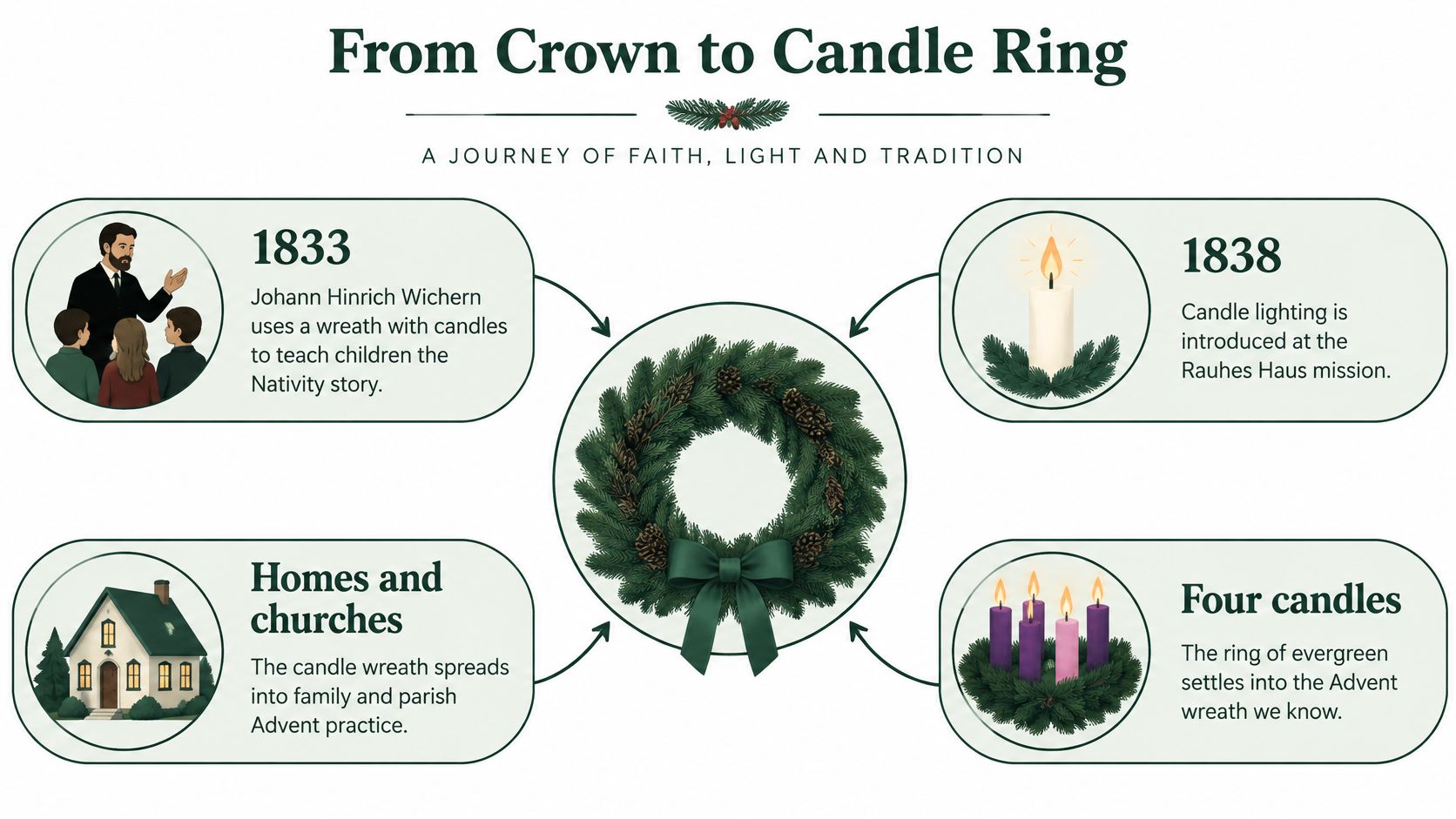
The Advent wreath's history centers on a different task: making the wait for Christmas visible. The German Christmas Museum's account of the Advent wreath identifies Johann Hinrich Wichern's work with children at Hamburg's Rauhes Haus as a key landmark. A precursor is described in 1838, while a candle-bearing wheel is documented in 1839. Those dates concern stages in an Advent practice, not the invention of every kind of wreath.
How the candle ring worked
Wichern's candle wheel served as a calendar children could see. Smaller candles marked weekdays, and larger ones marked Sundays. Lighting another candle as Christmas approached made the passing days tangible. The familiar evergreen ring with four candles for the Advent Sundays developed later as the custom spread.
Historical distinction: An Advent arrangement counts time in a church-calendar observance; a door wreath can simply mark seasonal welcome. Their circular shapes do not make their purposes interchangeable.
Practical design follows that purpose. Candle holders must be stable and noncombustible, with flames kept clear of needles, ribbon, and other flammable material. Never leave burning candles unattended. Flameless lights can preserve the sequence of growing light without an open flame. Wreaths for other holidays may celebrate other occasions without taking on an Advent role.
From Winter Greenery to the Christmas Door
The Christmas door wreath is better understood through household winter greenery than through any claimed first inventor. Keep the Faith's account of Christmas wreath history describes European evergreen decorating traditions, including practices associated with German Christmas greenery. The record supports a broad development, not an exact date for the first evergreen ring hung on a door.
- Evergreens entered winter homes. Their foliage remained green when many other plants did not.
- Households gave that greenery seasonal meanings. Welcome, celebration, and religious observance could coexist without being identical.
- Evergreen arrangements took different forms. Candle displays served Advent waiting; a wreath on a door served as visible household decoration.
- The door wreath became a familiar Christmas display. Its later use does not require every earlier crown or garland to be its direct ancestor.
Material is part of today's story too. From the Forest to the Door discusses greenery and wreath-making. Readers coordinating indoor decor can also browse holiday candle styling tips, while keeping decorative candles separate from the meaning and safety needs of an Advent arrangement.
Separating Myth From the Evidence
Claims that need qualification
- "The wreath started as a Christmas decoration." No. The Getty's account of ancient flower crowns places plant crowns in ancient ceremonial life long before Christmas door decorating.
- "Ancient Greek crowns were always gold or laurel." No. The competition mattered: olive, laurel, wild celery, and pine were among the plants used. Gold wreaths formed another ceremonial and funerary category.
- "Every evergreen wreath is Christian." No. A wreath's material does not establish the intention of the person displaying it; it might mark Advent, welcome guests, or honor someone who has died.
A practical test for historical claims
When an origin story sounds unusually neat, ask:
- Where did it happen? Olympia, a Roman ceremony, and a Hamburg children's institution are different settings.
- What does the date establish? A surviving object, a documented practice, and a later familiar form are different kinds of evidence.
- Does the claim preserve the object's purpose? A worn award, a funeral tribute, a candle calendar, and a door decoration should not be treated as one unchanged custom.
Historical distinction: The first household Christmas door wreath has no reliably documented date in the evidence discussed here. A gap in the record is better acknowledged than filled with a tidy origin myth.
Choosing a Wreath With Its History in Mind
Choose by purpose, then material, then placement. History helps clarify the occasion; it does not require a modern wreath to imitate an ancient object.
| Purpose | Material question | Placement question |
|---|---|---|
| Seasonal welcome or gift | Would fresh greenery and its changing appearance suit the occasion? | Will it hang on a door or be displayed indoors, with enough clearance? |
| Memorial tribute | Is the arrangement appropriate for the person and setting? | Does the cemetery allow that form and position, or is it for a home remembrance space? |
| Advent observance | Will the arrangement safely support candles or flameless lights? | Can it sit securely where people gather to follow the lighting sequence? |
Check the setting before choosing
Measure the space before selecting a door wreath, allowing for door movement and nearby hardware. For an outdoor memorial, confirm cemetery rules and use an arrangement intended for the gravesite. Fresh greenery has a seasonal display life and changes as it dries; a permanent ornament keeps a more consistent appearance. Neither choice needs an invented ancient pedigree.
Rockdale Wreaths crafts Christmas wreaths from fresh Maine balsam, pine cones, and natural greenery on its farm in Maine, with supporting farms. A fresh Christmas wreath can fit a door display or make a meaningful seasonal gift. If your purpose is remembrance, choose a memorial form suited to the site instead. Matching the wreath to its purpose matters more than claiming that any modern arrangement preserves an ancient ceremony unchanged.

