


Rustic Christmas Centerpiece Guide for Balsam Tables
By Rockdale Wreaths
Rockdale Wreaths Family
You've got a table that seats eight, a holiday coming, and a picture in your head of a low green runner down the middle with candles at each end. Then the box arrives, you set the piece down to see how it looks, and it's wider than you pictured. The serving dishes end up on the sideboard, and the person across from you is looking at balsam instead of your face.
The fix is measurement, handled before cones, ribbon, or candles enter the picture. A dining table is a working surface first. It has to hold place settings, serving dishes, and passing room, and it has to keep sightlines open so people can talk across it. The centerpiece gets whatever space remains after all of that.
A rustic Christmas centerpiece that works through a whole meal follows a fixed order. Measure the table. Pick a piece sized to the space left over. Keep any flame clear of the greenery. Add two or three accents and stop. Styling advice that starts with a photo to copy runs that order backwards, and a backwards order is how dishes end up crowded off the table.
Table of Contents
- What Makes a Centerpiece Feel Rustic
- Measure Your Table Before You Buy
- Candle Spacing and Safety at the Table
- Choose Accents That Fit a Maine Farmhouse
- Styling Rules That Keep the Table Uncluttered
- Keep Balsam Fresh While It Sits on the Table
- Rustic Centerpiece Questions and Next Step
What Makes a Centerpiece Feel Rustic
Rustic is defined by what you leave off the table. Balsam is the star. The tips stay loose and visible, the silhouette stays uneven instead of rounding into a tight dome, and no more than two or three accent types appear. Formal styling runs the other way: symmetry, stacked layers that bury the greenery, metallic overload, and one of everything.
| Feature | Rustic | Formal |
|---|---|---|
| Greenery | Loose, visible balsam tips | Tight, symmetrical dome |
| Accents | Two or three types, such as cones, berries, or plaid ribbon | Many types, stacked in layers |
| Finish | Natural cones, simple fabric, a touch of soft metallic | Heavy gold, glitter, matched ornaments |
| Shape | Uneven and low, with open space around it | Symmetrical and filling the table |
| Scent | Fresh balsam, noticed when guests sit down | Usually unscented |
That restraint does practical work. A centerpiece sits on a working surface, and the traits in the left column are what keep it usable. A low, open arrangement leaves sightlines clear across the table so guests see each other instead of greenery. Open space around the piece is where serving dishes, glasses, and elbows land during the meal. The uneven shape also reads as gathered rather than manufactured, which is the quality people mean when they call a table rustic.
The other half of the effect arrives before the food does. A low balsam runner carries its scent up as guests pull in their chairs, while the table is still empty enough to notice it.
Fresh balsam does most of that work by itself. The Maine Department of Agriculture, Conservation and Forestry's balsam fir guide describes balsam fir as having dark-green, short needles and a notably pleasant aroma, and identifies it as the most abundant tree in Maine. Short needles give a fine, compact tip that holds shape without a wire frame, which is why a balsam centerpiece doesn't need the rigid silhouette a florist's piece relies on.
One wrinkle is worth knowing before you shop. That same Maine guide notes that balsam cones point upward and break apart as they mature, leaving a central stalk instead of dropping whole the way the bagged decorative cones do. If you want visible cone texture on the table, plan on separate durable cones and let the balsam tips carry the green structure and the scent.
Measure Your Table Before You Buy
Measure first, always. The number you need isn't on the product page. It's on your dining table, and it decides whether the piece lives at the center of the meal or gets shifted to the sideboard halfway through.
- Measure the length and width, then count the seats. Width decides the format. A 40-inch-wide table takes a narrow runner; a 36-inch table usually wants a compact cluster instead. Seats decide how much of the length is already spoken for.
- Reserve clear tabletop per place setting. A published dining-room measuring guide recommends at least 18 inches of unobstructed tabletop per setting. I plan 18 to 24 for a holiday meal, because wine glasses and a bread plate take up room the plate alone doesn't.
- Size the piece to what's left. Subtract the reserved space from the table length and you have your middle run. The same guide puts a balanced centerpiece at about one-third of the table's length, which on a 6 to 8 foot table lands at a runner of roughly 20 to 36 inches.
- Keep the height down. That guide recommends staying below about 12 inches so guests can see across the table. Height in the middle of a table buys drama and costs conversation.
- Leave room at the edges. I keep 12 to 18 inches from the end of the arrangement to each diner, and the same again for serving dishes. Elbows count.
If you're still choosing the table itself, this dining table size guide sets out standard lengths and how many people each one seats without crowding, which is the number that makes everything above easy.
| Table length | Centerpiece length | Max height | Clear space per place setting |
|---|---|---|---|
| 6 ft (72 in) | 20-24 in | about 12 in | 18-24 in |
| 7 ft (84 in) | 24-28 in | about 12 in | 18-24 in |
| 8 ft (96 in) | 28-32 in | about 12 in | 18-24 in |
| Round or small square, under 5 ft | Compact cluster, not a runner | about 12 in | 18 in minimum |
A round or small square table under 5 feet doesn't want a runner at all. One compact cluster, set slightly off center, leaves the most usable surface for the food.
House rule: if the piece blocks a seated view or hides the serving spoons, it's too big, whatever the table length says.
If you're buying rather than building, our centerpiece collection includes the Ribbon Candy Centerpiece, and the middle-run measurement you just worked out is the number to match against any finished piece.
Candle Spacing and Safety at the Table
Start with the version that has no flame. Battery-operated or certified electric LED lights give you the glow without an ignition source, and they sit in the gaps of a balsam runner without raising a clearance question. Keep the wiring off wet foliage and check insulation, connections and sockets before each use. A cracked socket next to damp greens is a problem two minutes of inspection prevents.
Federal fire-safety guidance from the Department of the Air Force names candles and dried evergreen clippings among the common fire scenarios in holiday decorating. It also asks that decorations stay clear of exits and high-traffic edges, and that lights go off whenever the room is empty or people are sleeping.
Real candles are a choice, not a requirement. If you want them, the spacing figure to hold is a full 12 inches from anything combustible, the clearance a holiday table styling guide repeats from fire-marshal guidance. On a working table that pushes real flame outside the greenery entirely. Dry needles, cones, ribbon tails and linen napkins all sit within a flame's reach, and a runner sized to the table leaves no 12-inch pocket inside itself. Measure the bare tabletop at the ends and sides the same way you measured place settings; that open wood is where a live candle earns its spot.
Light them after the food is on the table and blow them out before you leave the room. A candle that needs supervising does not belong buried in the middle of a balsam runner.
If real candles are part of your holidays beyond the table, Shivora Candles home safety advice covers holders, wick trimming and burn time. A single candle standing in a balsam piece is its own spacing problem, and our guide to building single candle centerpieces walks through where it should sit.
| Candle type | Where it sits | Clearance from balsam tips | Notes |
|---|---|---|---|
| Flameless LED pillar | In gaps or along the runner | No flame, so keep wiring off wet foliage | Battery or certified electric only |
| Low real candle | In a holder on clear tabletop, outside the greenery | 12 in minimum from tips, ribbon and napkins | Attended only; light after the food lands, out before you leave |
| Tall taper in the middle | Center of the runner | Cannot hold 12 in while buried in greenery | Avoid, because it blocks sightlines and raises ignition risk |
Unattended flame is not a candle type worth a row. If nobody is in the room, nothing with a flame stays lit, full stop. The table stays decorated for days, not just for dinner, and between meals nobody is watching the middle of it, which is exactly when a piece gets left beside a drafty door or under a heat vent. Switch everything off when the room empties, and take the arrangement off the table at the first sign of heavy needle drop.
Choose Accents That Fit a Maine Farmhouse
The farmhouse palette stays short for a reason: every accent lands on a working table that already holds plates, glasses and serving dishes. Natural cones, a touch of berry, and plaid or a simple fabric ribbon cover the look. Everything else is a guest in the arrangement, and guests stay few.
| Accent | Where it earns space on the table | How much to use | Skip when |
|---|---|---|---|
| Natural cones | Between tip clusters, clear of the plate line | Groups of three or four, a few groups down the piece | Stacked deep enough to hide the greenery |
| Berries | Clustered toward one end of a runner, outside the serving zone | One group | Sprinkled end to end |
| Plaid or fabric ribbon | A narrow tie on a stem bundle, or a short bow | One tie or two short tails | Bulky bows that push into serving space |
| Light birch | Low against the dark needles, between cone groups | A few pale pieces | Combined with three or more other accent types |
| Soft gold or pewter | A single pick set low in the balsam | One or two picks at most | Used in quantity, which reads banquet hall |
| Glitter and oversized ornaments | Kept off the table entirely | None | Always, because glitter sheds onto plates and both read formal |
Cones do the work balsam can't. Tucked between the tips where candlelight reaches, a small group reads as something the woods dropped there. One judgement worth trusting: if a cone sits where a forearm lands while reaching for a dish, it belongs further inside the piece.
Berries carry the color, so one cluster does more than five scattered sprigs. A red berry group also settles the candle question, tying a red or ivory candle into the arrangement without a fourth accent family.
Plaid goes wrong faster than any other accent. Keep it narrow and short-tailed; the moment a bow needs both hands to fluff, it is gift wrap taking up serving room. Light birch earns its place only against dark needles, pale pieces doing contrast work the cones can't.
Metallics follow one rule: restraint. A single soft gold or pewter pick keeps the piece in the barn, while a quantity of them moves it to a banquet hall. Glitter and oversized ornaments stay out altogether, because they hide the greenery carrying the look.
If an accent wouldn't show up on the balsam tips or in the cones, it probably doesn't belong on the table. We finish our own pieces with that same bias toward the woods, and how we handcraft balsam on our Maine farm shows where the greenery starts.
Styling Rules That Keep the Table Uncluttered
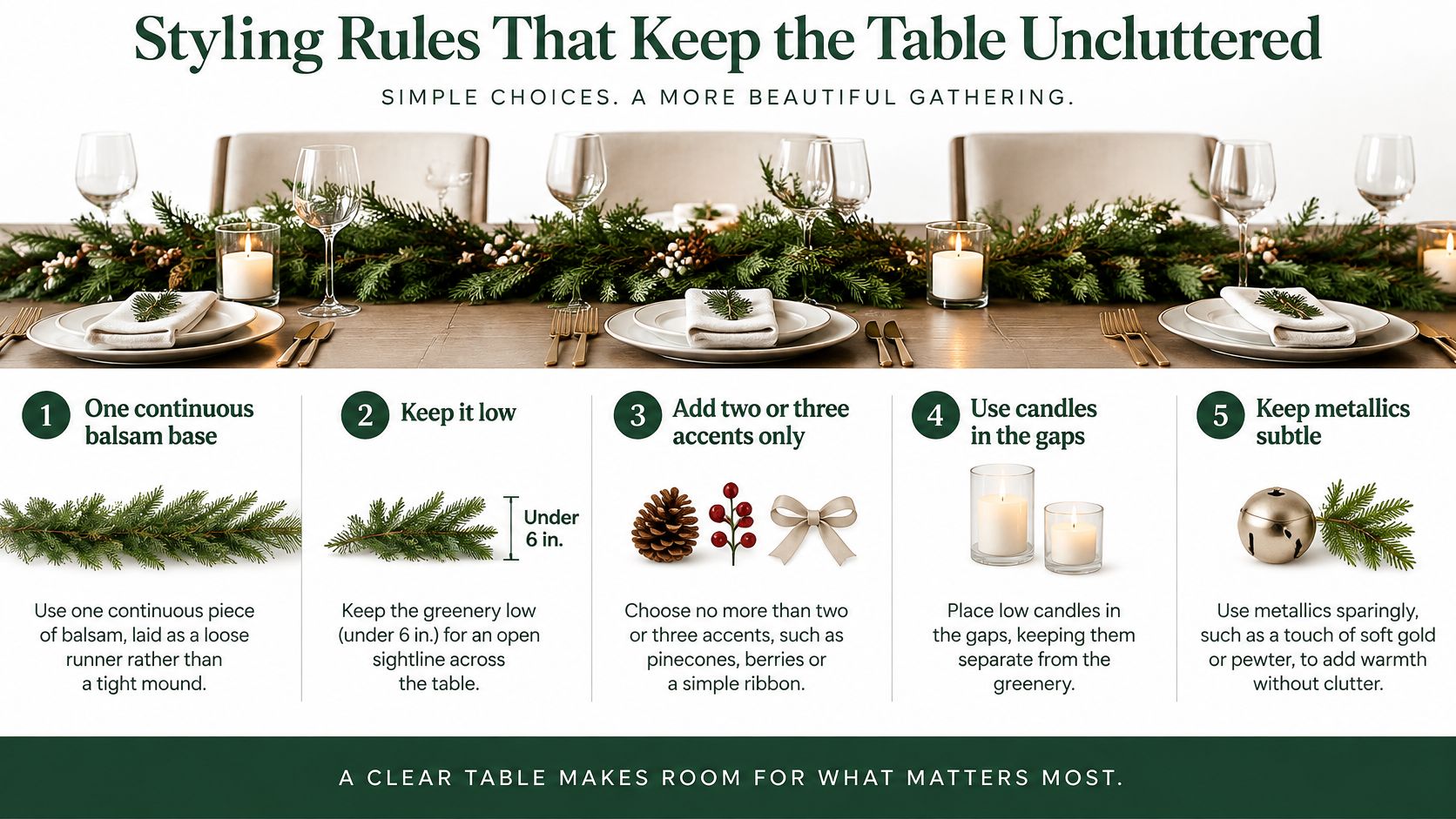
Five rules, applied in order, keep a working table clear. The first two govern the greenery itself; the rest protect the meal happening around it.
-
Lay one continuous base as a loose runner. A runner shows the balsam tips the whole way down; a tight mound hides them and eats twice the table. One base, then stop.
-
Cap the height at the sightline. One styling reference recommends about 12 to 14 inches on a standard 30-inch dining table, and on a working table I hold to the lower end, about 12 inches, so a seated guest sees over it. A single slender element gives vertical interest without a wall of greenery.
-
Dress the centre line only. Run the greenery straight down the middle of the table and leave bare wood beside every place setting, plus clear landing spots where the serving dishes will go. If a dish has to sit on the balsam, the piece is too wide.
-
Place accents in small repeated groups. Each accent family appears in a few tight clusters along the runner rather than sprinkled evenly, which reads gathered rather than scattered.
-
Run the seated check before the meal. Sit at each place, look across, and reach for where the serving dishes will be. If you can't see the person opposite or reach a dish without lifting the arrangement, remove one accent group before adding anything.
That's the whole job: a low runner, bare wood at the settings, and a final check from the seats rather than from the doorway.
Keep Balsam Fresh While It Sits on the Table
Fresh greenery is a perishable product. It looks its best the day it arrives, and everything after that is a slow negotiation with indoor air.

Cut balsam loses water faster in heated indoor air, which drives needle brittleness, color loss and flammability. The National Park Service guidance on decorating safely advises keeping live greenery fresh and away from ignition sources and heat, and notes that the National Fire Protection Association warns drying natural greenery becomes increasingly flammable over time.
In practice that means a cool room, no radiator or heat vent underneath the piece, no fireplace draft, and no direct sun through a south-facing window. Water the base if the design allows it. Many arrangements are built in foam or with wrapped stems that won't take water at all, so check before you pour. Misting does less than people hope.
Touch a few tips each day. When needles feel dry, snap instead of bending, or drop at a touch, the piece is past its best and should come off the table. Expect days rather than weeks on a working table, which is why I'd set the piece out close to when company arrives and let it serve the week of visits rather than the entire season. Our notes on maintaining fresh balsam fir centerpieces cover the daily routine in more detail.
Here's the finished look in motion, candles, cones and all:
When it comes down, pull the wire, ribbon and any floral foam out first, then check your town's rules before the greenery goes anywhere near a compost pile. Untreated balsam is one thing. Glittered, painted or wired material is another.
Rustic Centerpiece Questions and Next Step
How do I size it for a table with a leaf?
Measure the table in the exact setup you'll use for the meal. A leaf can turn a comfortable 6 foot top into an 8 foot one, and the same 20 to 36 inch middle run may leave crowded ends if place settings still need 18 to 24 inches each. If adding the leaf steals serving room, keep the centerpiece shorter and slimmer rather than forcing the full runner look.
Can the centerpiece stay out between meals?
It can, if the room stays cool and the piece sits away from heat, drafts and sun. The tradeoff is freshness: every warm evening shortens its table life. For a working table, I'd treat it like good flatware, set it before guests arrive, lift it for carving or buffet service, and store it somewhere cool overnight if the dining room runs warm.
What if serving dishes need the middle?
Build in a landing zone before the meal. On a full table, keep the greens low near 12 inches and leave one clear stretch for platters, or split the arrangement into two smaller pieces with open space between. A centerpiece that has to slide during gravy service is sized wrong, even if it photographed well.
How do kids, pets or elbows change the plan?
Use flameless light, skip loose cones at the edge, and keep ribbon tails inside the footprint. Any piece that can be hooked by a sleeve or paw needs more clear tabletop around it, so choose fewer accents and a lower profile rather than relying on guests to be careful.
When the measurements are settled, the order is simple: table setup first, middle run second, height and candle plan third. Rockdale Wreaths has cut fresh balsam on our family farm in Jonesport, Maine since 1994, and the centerpieces are a separate collection made from the same Maine balsam for tables and mantels. Bring your table length and leaf plan to Rockdale Wreaths, then choose the piece that leaves room for dinner.

