


Christmas Traditions Wreaths: Meaning, Customs and Care
By Rockdale Wreaths
Rockdale Wreaths Family
Your neighbour's wreath is still on the door in the third week of February, and yours came down with the tinsel on New Year's Day. Neither of you is doing it wrong. One evergreen circle carries several traditions at once, and the practical rules about where it belongs and when it comes down are just as mixed.
Table of Contents
- Wreath Traditions at a Glance
- Where the Christmas Wreath Came From
- What the Circle and Evergreen Mean Today
- Maine Balsam Wreaths and the Regional Tradition
- Memorial Wreaths and Grave Blankets
- Sending Wreaths as Gifts and Newer Traditions
- Keeping Wreaths Fresh and Safe Indoors and Out
- Leaving a Wreath Up for Nesting Birds
Wreath Traditions at a Glance
| Wreath type | Where it hangs or sits | Traditional role | Who it serves |
|---|---|---|---|
| Door wreath | Front door | Welcomes family, friends and neighbors during the holidays | Households and visitors |
| Window wreath | Inside or outside a window | Decorates the house and can be enjoyed from both sides | Household and passersby |
| Centerpiece wreath | Table or mantel | Brings fresh balsam indoors where families gather for meals | Family and guests |
| Cemetery wreath or grave blanket | Grave site | Remembers loved ones and includes them in the Christmas season | Families and memorial sites |
| Advent wreath | Table, with four candles | Counts the four Sundays before Christmas | Church and home devotion |
| Gift wreath | Recipient's home or office | Shares a regional tradition with someone far away | Friends, family, clients and employees |
These aren't niche objects. In 2025, 49%–51% of British households that put up Christmas decorations included a wreath, according to a YouGov survey on Christmas decorating published in November 2025.
- Door wreath: the format most households buy first, hung at eye level where a visitor meets it before the doorbell.
- Window wreath: smaller and lighter, hung where the room can see it from the inside and the street can see it from outside.
- Centerpiece wreath: lies flat, so the greenery sits at arm's length on the table instead of at shoulder height on a door.
- Cemetery wreath or grave blanket: goes to a grave, and the blanket version lies on the ground rather than hanging at all.
- Advent wreath: sits flat and takes candles, which is the one thing a door wreath should never do.
- Gift wreath: travels, so arrival timing becomes part of what the recipient experiences.
Read the table the way you'd lay out a room. Match the wreath to the place it will hang first, then to the meaning you want it to carry. A centerpiece nailed to a front door loses the flat circle that does the symbolic work, and an Advent ring hung outside loses its candles.
The differences between these six aren't decorative flourishes. They change where a wreath belongs, when it should arrive, and what you do with it once the holiday is over.
Where the Christmas Wreath Came From
Long before anyone hung greenery on a door, a circle of leaves marked a person rather than a season. In ancient Greece, olive, pine, laurel, celery or palm wreaths went to Olympic athletes, poets and orators, according to English Heritage's history of Christmas greenery. The circle sat on the head of someone who had earned public notice, and the material changed with the occasion.
Rome added a second layer. Laurel crowns honoured civil officials and returning warriors, and the New Year festival known as the Kalends turned greenery into a gift, with wreaths, garlands and small presents exchanged at the turn of the year. That habit of giving an evergreen circle away in December is older than Christmas itself.
Four stages, four objects: the athlete's crown, the official's laurel, the parish holly, the door ring.
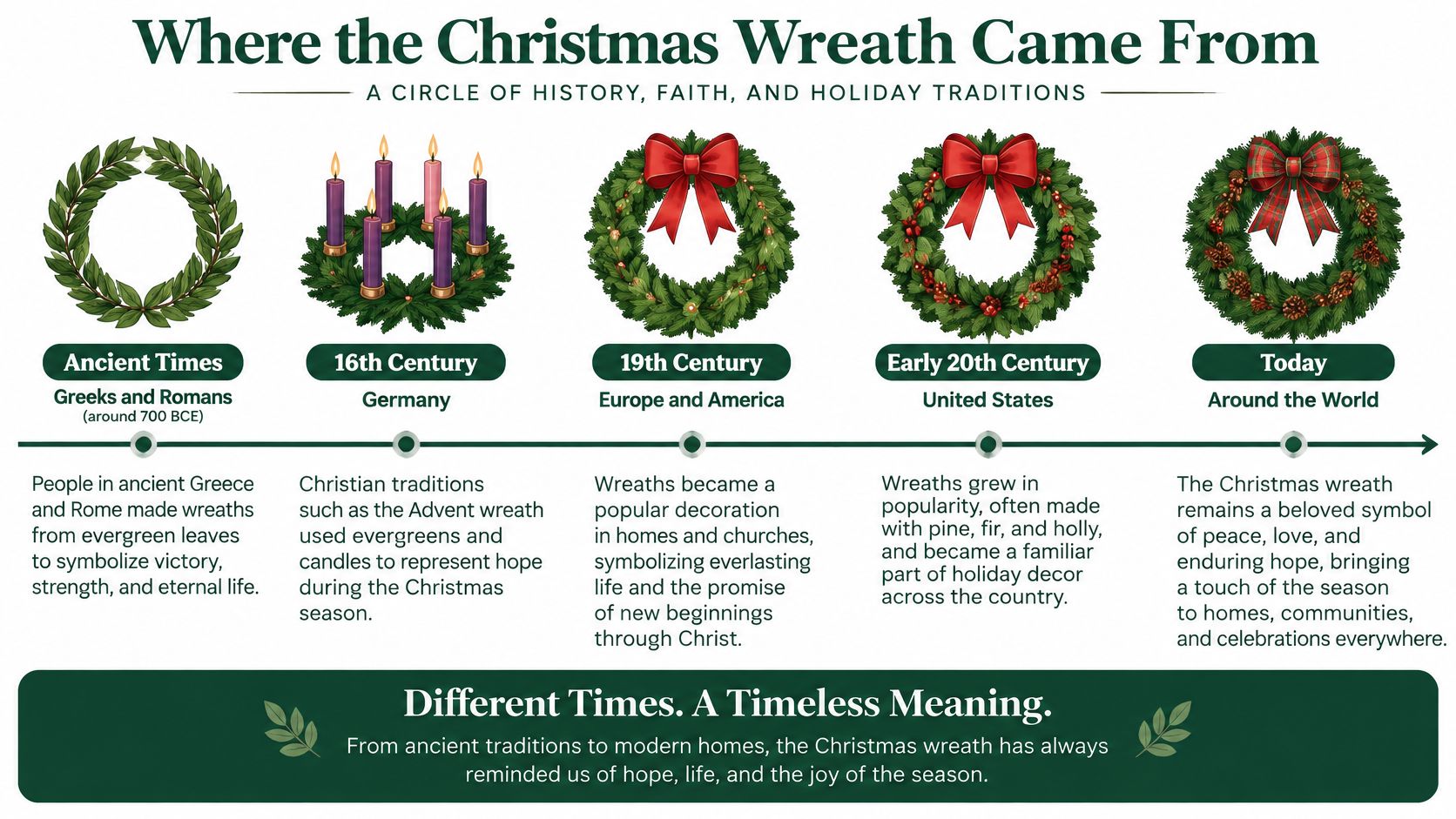
Winter gave the evergreen its third meaning. Foliage that stayed green through the dormant season read as continuity and life at a time of year when everything else had stopped growing, which is why the material survived long after the laurel crown lost its civic job.
By the late Middle Ages, the church had folded greenery into the season. Church records across Europe commonly documented purchases of holly and ivy, and private homes were decorated too. A 1444 account recorded London homes and parish churches decorated with holly, ivy, bay and other green plants that were available at that time of year. Christian interpretation then added the fourth layer, reading evergreen foliage as eternal life.
Four Layers in One Circle
- Ancient Greece: the idea that a circle marks achievement.
- Rome: the habit of giving greenery as a gift at the turn of the year.
- Medieval Europe: the practice of bringing cut greenery indoors for the season.
- Nineteenth-century households: the front door as the place to show it.
The door step came last. In the 19th century, wreaths increasingly appeared on front doors, where they were sometimes called "welcome rings," built from holly, ivy, pine cones and ribbons. That combination is still the basic decorative language of a fresh Christmas wreath today.
No single origin explains the object on your door. It's an athletic crown, a New Year gift, a parish decoration and a Victorian welcome sign, layered in that order.
What the Circle and Evergreen Mean Today
Two wreaths of the same size, made from the same balsam, can carry entirely different messages, and the difference sits in the setting rather than the greenery. The Britannica entry on the wreath sets out the layers: Greek and Roman wreaths signified achievement, honor and victory, winter greenery represented persistence and renewal, and the Advent wreath developed as a countdown ritual. Set those side by side and you have an object that means whatever the context tells it to mean.
So is every Christmas wreath religious? No. An ornamental wreath is decoration: it hangs, it's admired, it comes down in January. An Advent wreath is a ritual object with four candles, one for each of the four Sundays before Christmas, as Britannica's overview of Christmas describes. The two look related and behave nothing alike.
The circle itself is the reason the form survived. It has no beginning and no end, which is exactly the shape you want for continuity, whether you read that as eternity, the turning year, or the return of the same decoration each December.
The test that settles most household arguments: if a wreath holds candles and gets lit on a schedule, it's ritual. If it hangs and gets admired, it's decoration. The same greenery can do both jobs, but not on the same afternoon.
Three Questions Before You Choose Symbols
Households read the same circle differently. A secular family may see seasonal style and a warm door. A Lutheran or Catholic household may see hope and eternity. A non-Christian neighbour walking past may read it as a Christian marker, or as nothing more than winter decoration. None of those readings is a mistake, which is why symbols deserve a decision rather than a default.
For a business, an interfaith household or a public storefront, the safe choice is a wreath without religious symbols when the goal is general welcome, adding specific symbols only when the recipient or household shares that meaning. Ask three things before you pick:
- Who will see it? A door seen by strangers needs a broader reading than a table seen by family.
- What is the setting for? A memorial, a client thank-you and a front-porch display ask for different restraint.
- Does the recipient expect a religious reading? If yes, symbols reinforce the gift. If not, they can misfire.
Maine Balsam Wreaths and the Regional Tradition
Maine makes wreaths at a scale that surprises people who think of them as a kitchen-table craft. Balsam fir grows throughout the state, is Maine's most abundant tree, and is favoured for Christmas trees and greens, with many tons of branch tips collected each fall to make wreaths, according to University of Maine forestry guidance reported by the Portland Press Herald. The same report, citing University of Maine agriculture and nontimber-forest specialist Dave Fuller, estimates that about 2 million evergreen wreaths are made annually in Maine, with an estimated value of $75 million.

The craft has specifications, not just habits. Traditional Maine Christmas wreaths are double-faced, meaning the greenery is arranged to present a finished appearance from both sides rather than only from the front, according to University of Maine Cooperative Extension. That same publication cites Maine Christmas Tree Association standards requiring balsam-fir brush to be collected after November 1 and only after at least three consecutive nights at 20°F or colder. Harvest crews snap tips by hand, roughly 1 to 2 feet from the end of a branch, which is why the raw material arrives intact instead of crushed.
Here's the same work on the farm that supplies our own wreaths:
Those rules exist for durability. Brush cut before the cold nights set in holds up poorly, and a single-faced wreath looks unfinished the moment it swings against glass or hangs where a hallway mirror catches the back of it. For gifting, the double-faced build is the quiet advantage: a recipient in a different household gets a wreath made from the same characteristic balsam, shaped by a recognised Maine method, and it looks complete from whichever side the door opens.
How to Tell a Maine Balsam Wreath From a Generic Evergreen
- Balsam tips: fine, flat needles with a scent that carries across a hallway.
- A double-faced finish: greenery on both sides, not a cardboard disc with one decorated face.
- A shape that looks complete from the back: hold it up reversed. If the reverse side is bare wire and stems, it isn't built to Maine standards.
The trim changes, the base doesn't. A design such as Celtic Christmas sits alongside the traditional decorated wreaths in the range, and if you want the longer version of how the farm builds them, the Rockdale Wreaths story follows the balsam from Jonesport land to the finished door.
Memorial Wreaths and Grave Blankets
Memorial greenery has its own tradition, and its best-known example started in Maine. Wreaths Across America places balsam wreaths on veterans' graves at Arlington National Cemetery and other cemeteries, and its Maine woodland supplies branch tips for tens of thousands of wreaths per day during the season, according to News Center Maine's coverage of the program. Volunteers have returned to Arlington annually and placed wreaths in a different cemetery section each year.
That pattern is the whole point. A cemetery wreath is a coordinated remembrance arrangement placed at a grave, not a seasonal ornament meant to welcome visitors or dress up a house. The same logic produces grave blankets, which use evergreen branches as larger ground-level arrangements around a burial site, and cemetery hangers, which let a memorial piece sit securely where a door hook would be useless.
Practical rule: a grave is not a front porch. Check the cemetery's rules on what may be placed and how it must be secured, and confirm the date the arrangement should arrive rather than the date you'd hang a door wreath.
Rules vary widely by site, so it's worth comparing cemetery-approved memorial decorations before ordering, especially where grounds crews clear arrangements on a fixed schedule. Families who want the larger ground-level format often choose a grave blanket for exactly that reason: it reads as a considered tribute rather than a door wreath that lost its hook.
Then there's the timing. A door wreath can go up the first weekend of December and be forgotten until January. A memorial arrangement usually has a date attached, whether that's the anniversary of a death, a birthday, or the week before Christmas when the family visits together. Confirm which date matters before the order goes in.
Visiting is part of it too. Families include their loved ones in the season by going to the site, standing in the cold for a few minutes, and choosing an arrangement that suits the grave rather than the house. Some cemeteries allow only certain sizes, some prohibit wire, and some remove everything after a set date, so a quick phone call saves an expensive mistake.
Sending Wreaths as Gifts and Newer Traditions
The gift version of the tradition is simple and powerful: families send fresh Maine balsam wreaths to friends and relatives across the country, sometimes to several households at once, so people spending Christmas in different places are still sharing the same piece of a Maine Christmas.
Plan it in the order the recipient experiences it:
- Decide who receives one. One household, four siblings, or a client list, and pick the number before anything else.
- Collect addresses and delivery dates. Note each one, including work addresses, and remember that timing matters as much as the wreath.
- Pick the type for the place it will hang. A front door, a window, an office reception desk or a grave each points to a different format.
- Confirm the arrival window. Standard delivery for Christmas wreaths typically runs 5–7 business days after the order leaves the farm, and shipments include tracking so you can follow each one.
- Add a short note on keeping it fresh. A line about soaking and placement turns a nice gift into one that's still handsome on Christmas Day.
The group version scales without changing the product. Businesses send one wreath to each employee household or client office, employee welcome programs hand a new hire something that isn't a branded mug, and holiday programs order in bulk so every address receives the same thing on roughly the same day. Decide the recipients, then the quantity, then the addresses, then the timing.
A newer tradition works differently. Rockdale Forest tree recognition lets someone dedicate a tree on the same Maine farm to a person who matters, leaving a personal message that can be revisited online. One meaningful way to use it is to share the dedication link on an anniversary, a birthday or another important date, so family and friends have a place to return to, read the message and remember the person or occasion connected to the tree.
A wreath gift arrives once and is shared by everyone in the house. A dedication keeps a place open, so people can come back to it on the days that need marking.
Choose between them by the calendar. If the recipient needs something on the table this December, send the wreath. If the date that matters is in June, or if the point is to keep a name present across years rather than weeks, the tree dedication carries further.
Keeping Wreaths Fresh and Safe Indoors and Out
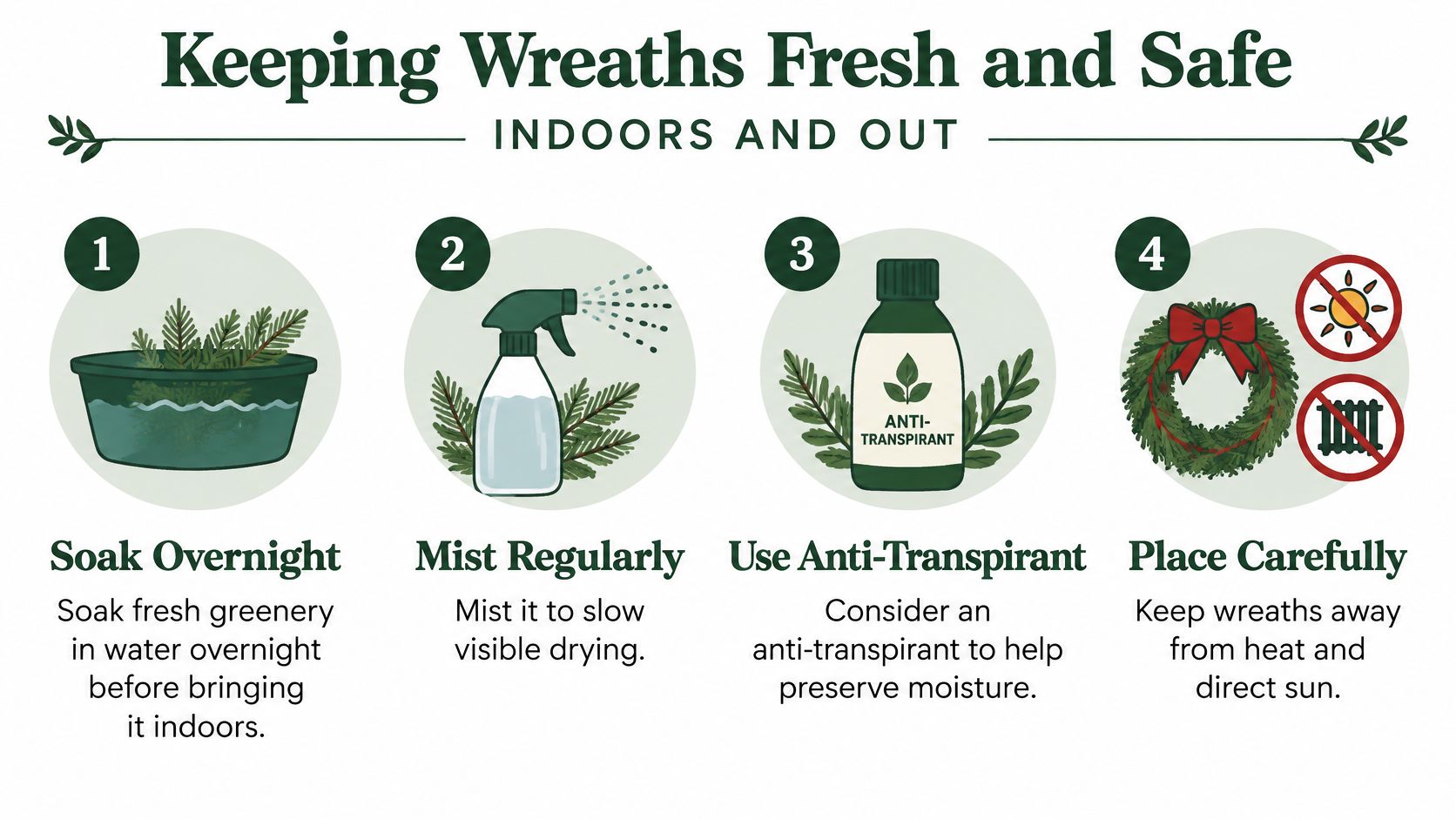
Hydration and heat are the two things you control, and both are fire decisions as much as aesthetic ones. Clemson and Illinois Extension guidance on seasonal evergreens is blunt about the sequence: rehydrate first, then manage the room, then keep checking.
- Soak it overnight. Immerse fresh greenery in water before it comes indoors so the cut foliage can take up moisture again. A dry wreath at the start never catches up.
- Mist it as it dries. Misting slows visible drying, and an anti-transpirant can reduce moisture loss once the foliage has dried on the surface.
- Move it away from heat. Keep wreaths clear of radiators, heating vents, fireplaces, candles, space heaters and strongly sunlit windows, because warm, dry conditions accelerate moisture loss.
- Test the needles. They should bend rather than snap. That flex is the most reliable sign the greenery is still holding water.
- Pull anything shedding, brown-tipped or brittle. Dry greenery becomes more flammable, so remove or replace it rather than leaving it up for appearance's sake.
Placement changes the routine, so look up your own spot:
| Placement | Main risk | Action |
|---|---|---|
| Outdoor, cool and sheltered | Drying from wind and sun is lower | Test needle flexibility and replace shedding or brittle greenery |
| Outdoor covered porch | Wind and rain move lighter pieces | Use a lighter balsam piece or secure lower greens |
| Indoor, near a sunny glass door | Warm dry air speeds moisture loss | Inspect more often and expect a shorter display life |
| Indoor, near a radiator, vent or fireplace | Heat dries foliage and raises fire risk | Move away from the heat source and remove brittle greenery |
| Indoor, near candles or space heaters | Open flame and direct heat | Keep well clear; use candles only on an Advent ring |
| Table centerpiece | Heat and candles nearby | Soak fresh greenery overnight before indoor placement |
The difference between an outdoor and an indoor wreath isn't prestige, it's workload. A cool, shaded, sheltered position outdoors reduces drying stress and buys you weeks. An indoor wreath next to a sunny glass door needs more frequent inspection and has a shorter expected display life, which is worth knowing before you hang a large piece in the hottest corner of the house.
Before you hang anything: check the hook holds the weight, keep dried arrangements away from open flame, and treat every candle as a supervised event rather than a decoration.
Advent candles belong on an Advent ring, in a holder designed for them, set well away from greenery and never left burning in an empty room. A decorative wreath made from fresh cut balsam was never designed to hold a candle, and tradition doesn't change that. For storage and off-season handling, these wreath care and storage notes cover what to do once the wreath comes down, and Shopifarm's Christmas tree care guide is a useful companion for anyone keeping cut evergreen alive through a long season.
Leaving a Wreath Up for Nesting Birds
One after-Christmas habit Maine families mention more than any other: instead of pulling the wreath down the week Christmas ends, they leave it hanging a little longer so birds can use the greenery when building nests, and enjoy watching the visitors arrive. It's a small decision, and it works better when you make it deliberately.
- Decide whether this wreath stays. One wreath becomes the nest site, the rest come down with the other decorations.
- Keep a secure, wreath-shaped support. A Hudson Valley gardening source reports that multiple customers left wreaths hanging through spring and saw birds nesting in them, with conifer greenery and grapevine giving birds a familiar structure while nearby berries can add a food source, per Scenic Hudson's guide to bird-friendly decorations.
- Know who moves in. Cornell-affiliated NestWatch guidance identifies house finches, American robins, Carolina wrens, mourning doves and dark-eyed juncos among species known to nest in wreaths, with nests generally placed on the inside bottom of the wreath, using the door and wreath as support.
- Don't count on natural materials. Birds may use synthetic wreaths too, so a real balsam wreath is helpful but not a requirement. The attraction is the shape and the secure footing.
- Remove anything that could trap a bird. Netting, loose strings and stray wire go first, before the wreath goes up, not after a bird is tangled.
- Take it down when the greenery fails. If needles snap, shed or turn brittle, the wreath is no longer a nest site, it's dry fuel beside a door.
Set one removal date and tell the household which it is: right after Christmas, or after nesting season. A shared decision prevents the February standoff where one person wants the door back and another is watching a finch.
A wreath that arrives from the shop is made for a front door, a gift, a business or a grave, and the front-door ones are the ones birds find. If you're ordering with this in mind, a fresh piece from the farm in Jonesport will hold its structure longer than an imported wreath that was already drying when it shipped.
Rockdale Wreaths makes fresh balsam wreaths, centerpieces and grave blankets on its farm in Jonesport, Maine, and ships them to the 48 contiguous states with tracking on every order. Whether the wreath is headed for a front door, a client's office, or a grave you'll visit in December, see the fresh balsam wreaths at Rockdale Wreaths and plan your delivery dates before the season fills up.

