

Balsam Coupon Code: How to Check Savings Before You Order
By Rockdale Wreaths
Rockdale Wreaths Family
A wreath sits in your cart, and a coupon site promises a balsam coupon code if you click through one more page. Its countdown makes the deal look urgent, but the code may be expired, ineligible, or simply a hook to get your click.
You shouldn't have to hunt through coupon pages to find out what Rockdale Wreaths is offering. Check Rockdale's own site for current promotions, and sign up for the newsletter to get the latest Rockdale News. If you do find a code elsewhere, test it at checkout and compare the delivered total before you order.
Table of Contents
- Why No Balsam Code Can Be Promised in Advance
- Savings Types and Where Each One Applies
- Where to Find Current Promotions
- How to Verify a Code Before You Order
- Compare the Final Price, Not the Percentage
- Order Now or Wait Based on Delivery Deadlines
Why No Balsam Code Can Be Promised in Advance
You paste the code, and one of two things happens. The cart rejects it outright, or it accepts the code and then drops the discount the moment you change the shipping option. Either way, you're staring at the same total you started with.
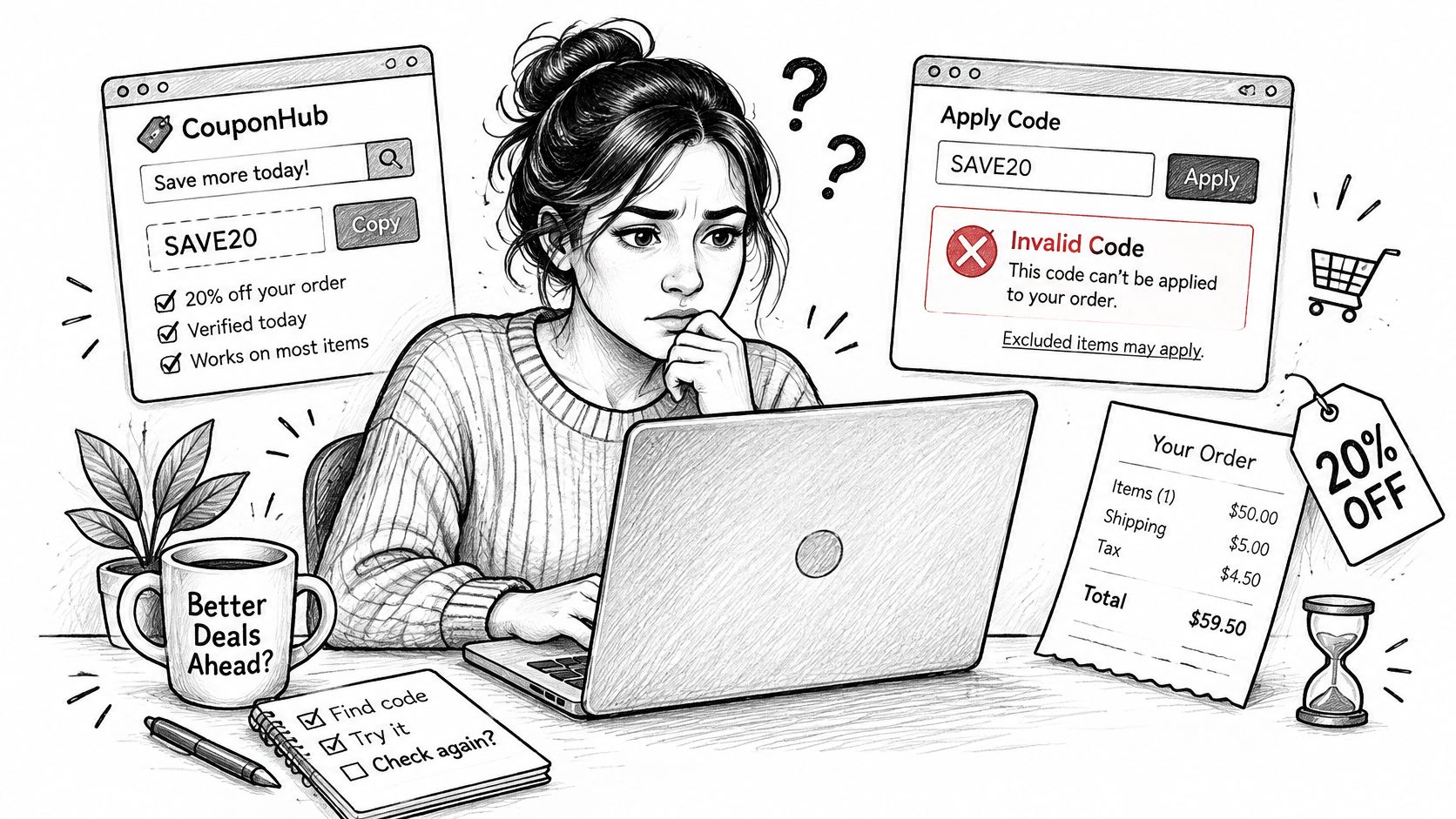
Some coupon listings outlive real promotions. Others use a promised discount and an urgent-looking countdown to draw clicks without showing that the code works on your order. Skip the pressure: check Rockdale Wreaths for its current promotions, then use checkout to confirm any code you want to try.
Searching first is still the right move. EMARKETER's summary of SimplyCodes coupon data reports that in 2024, 59% of online shoppers used Google or another search engine to find a discount code before making an online purchase. Most of those shoppers found something. Fewer found something that still worked.
The rule that governs everything else: treat every code as unverified until it's applied to a regular retail order on the live checkout page and you can see the discount line in the order summary.
The word "regular" carries weight. Coupons aren't accepted on fundraiser programs or special offers, and they're valid only on regular retail purchases. A code that works perfectly on a single fresh wreath can be ineligible the moment your cart holds a fundraiser item or a discounted special, and the coupon page will almost never mention that. Assume coverage you don't have, and you can pick the wrong saving and overpay on the delivered total.
So the search itself won't tell you what applies. The cart will tell you what applies to your order.
Savings Types and Where Each One Applies
Seven kinds of saving show up around fresh wreaths and balsam decorations, and they don't behave alike. A code that works on one order type can be ineligible on the next, so judge every saving by what it does to the final delivered price rather than by the headline percentage. You can browse the full range in the online shop to see which styles you're choosing between.
The seven savings types side by side
| Savings type | Where it applies | Check before ordering |
|---|---|---|
| Promo code on regular retail | Regular retail purchases only | Apply the code to a regular wreath order and confirm the discount line appears |
| Free or discounted shipping | Shipping charge at checkout | Compare the shipping line against the code's dollar value |
| Multi-pack orders | Orders needing more than one wreath | Ask whether a code covers multi-packs, since the code page often does not say |
| Bulk orders | Businesses, events and large-scale decorating | Request the per-unit price at your quantity, then compare it against the code's discount |
| Corporate and client-gift orders | Employee gifts and client thank-yous | Request corporate pricing rather than assuming a code applies |
| Seasonal special offers | Promotions run by the business itself | Read the offer terms for exclusions, because coupons are not accepted on special offers |
| Fundraiser programs | Organized seasonal sales | Coupons do not apply; ask how the program is priced instead |
Promo code on regular retail is the plainest case and the one most codes are written for. Add a single full-price wreath, apply the code, and confirm a discount line appears in the order summary. Cedar Pine & Balsam is one of the fresh wreath styles sold without a bow theme, alongside Northern Pine and Timber Trail, and any of the three works as a clean test item.
Free or discounted shipping lives in a single line at checkout, and that line is the one most shoppers skip. The break-even is simple arithmetic: a code that saves less than the shipping charge is the worse deal, so read the shipping line first and apply the code second.
Multi-pack orders are where percentage codes usually earn their keep. A study of 3,827 online FMCG customers found that percentage-off general coupons produced higher spending and more items per order than dollar-off coupons, according to the Monash University analysis of customer responses to discount coupons. Stores design percentage codes to reward a bigger basket, so if you're ordering two or three wreaths, ask directly whether the code covers a multi-pack. The code page usually stays silent on it.
Bulk orders for a storefront, an office lobby, a church, or a row of barn doors are priced through a conversation, not a coupon field. Bulk and fundraising orders carry volume discounts, so ask for the per-unit price at your exact quantity and set it against whatever the code would have taken off.
Corporate and client-gift orders follow the same path. If you're sending wreaths to clients or a remote team, request corporate pricing rather than hunting for a code. Branding and personalization options vary by order type, and a short gift message can be included with each wreath, so the quote you get back reflects what you ordered.
Seasonal special offers are promotions the business runs itself, and the answer here is firm: coupons aren't accepted on special offers. Read the offer's terms, get its real discount, then compare that number against the code's number. You get one or the other, so pick whichever lowers the delivered price more.
Fundraiser programs operate on their own pricing, and coupons don't apply to them at all. If you're running a seasonal sale for a school or a team, ask how the program is priced from the start. Fundraising and bulk purchases qualify for volume discounts, which is where the saving sits.
Ask these three questions before applying any code: Does it cover this order type, including multi-packs and bulk? Does it apply before or after shipping is added? Does it exclude sale items and special offers?
Where to Find Current Promotions
Start with Rockdale Wreaths when you want to know about current promotions. Coupon sites may advertise discounts without confirming that they work on your order. SimplyCodes' coupon sentiment report found that in 2024, 54% of surveyed online shoppers said they had increased their coupon-code usage during the prior year. With so many people searching for codes, an eye-catching listing is no substitute for checking with the business. You can also sign up for the newsletter to get the latest Rockdale News.
Where to check, in order
- Start with Rockdale Wreaths. Check the site for current promotions and seasonal offers, or contact Rockdale if you have a question about your order. Sign up for the newsletter to get the latest Rockdale News, too.
- Open the product page for the wreath or centerpiece you want. Read the listed price, any size note, and any offer terms printed there. A larger wreath, or one with more dressing, carries its own price on its own page, so that's where the current number lives.
- Read the terms of any special offer you see, including exclusions for fundraiser programs and bulk orders. A headline offer and a coupon are often mutually exclusive, and coupons count only on regular retail purchases anyway.
- Be skeptical of third-party coupon lists. A page that promises a discount to get your click has not confirmed one for your order. If you find a code there, treat it as unverified until Rockdale's checkout applies it.
Write down the date you checked. Promotions move through the holiday season, and a code that was dead in early November can be replaced by a different offer in December. If you want a wider sweep of seasonal listings between checks, browse daily freebies and hot deals from KeepCart as a lead source, then verify anything you find at the cart.
Checking tells you what exists. Testing tells you what it's worth. Whether a listed code applies gets answered on the cart page, which the verification routine in the next section walks through step by step.
A page showing no promotion today isn't evidence that none will appear later. Set a reminder to recheck before your last safe order date, and run the verification steps each time you do. Checking once and assuming the answer holds for six weeks is how people end up paying full price on a deadline.
How to Verify a Code Before You Order
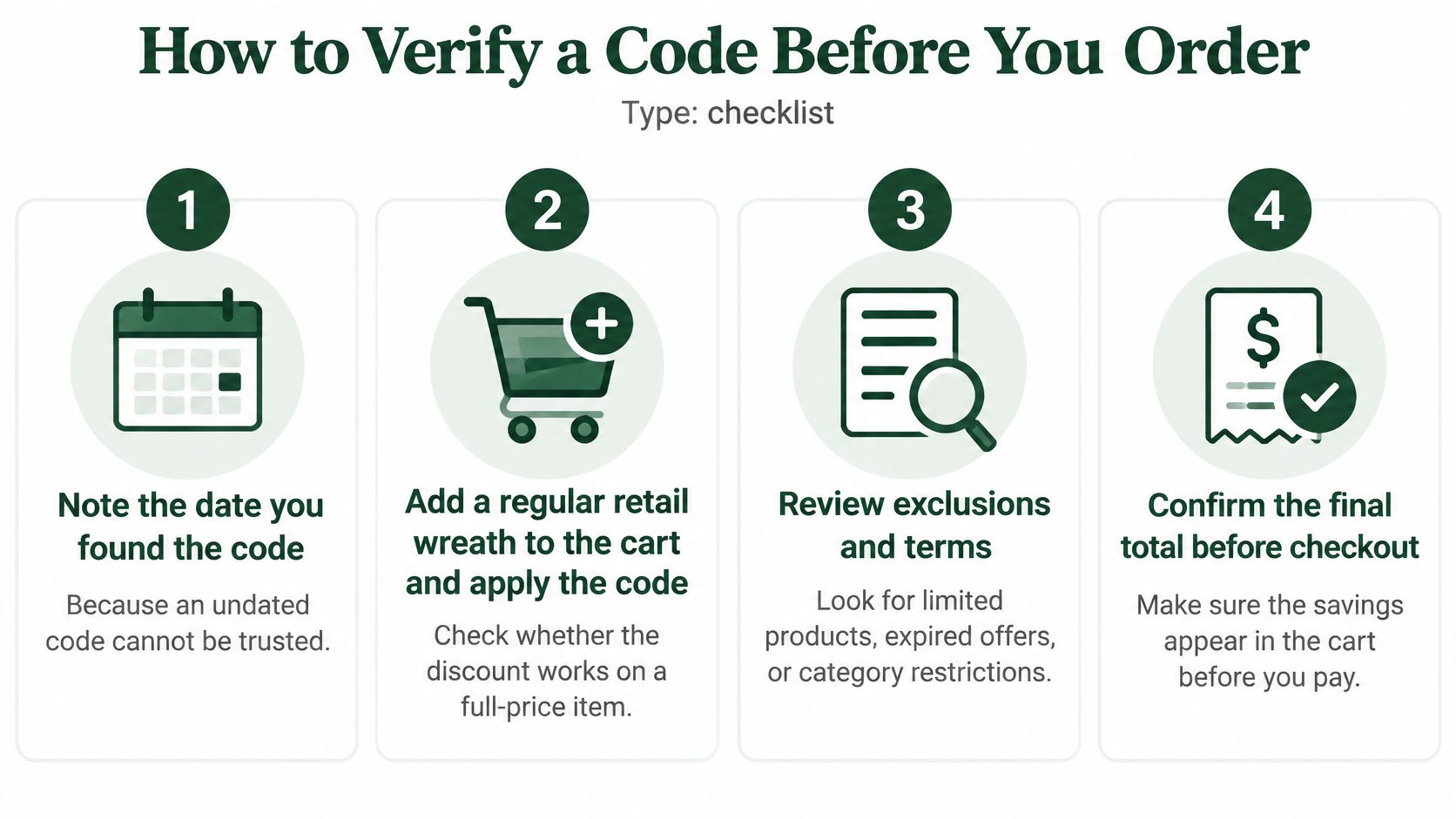
A code passes or fails in the cart, and the whole check takes about five minutes. Run it on the order you plan to place, in this order, before you enter payment details.
- Copy the code exactly as it appears. Match the capitalization, spacing, and hyphens. A mistyped code produces the same rejection as a dead one, and the error message won't tell you which happened.
- Test it on the order you're placing. A code can clear on one wreath and fail on a different size or a more heavily dressed option, because each is priced on its own product page. Verifying on a small placeholder and then buying a larger wreath means you tested a different purchase.
- Watch the order summary. Check three lines: the discount line, the subtotal, and the shipping charge. A promo banner can sit above the subtotal without moving the total, and that means nothing was applied.
- If it's rejected, recheck once, then stop. Enter it again to rule out a typo. After that, remove it and take the listed price as your number, because pasting a dead code repeatedly produces the same answer.
- Compare the delivered total with and without the code. The dollar difference between those two numbers is the code's real value on your order. Write it down. That figure, more than the advertised percentage, is what the code is worth to you.
- Save the confirmation email and the code you used. Keep both until the order arrives, so you have a record if the discount on the receipt doesn't match what checkout showed.
Some rejections are eligibility, and no re-entry fixes them. Coupons are accepted only on regular retail purchases, so a cart holding a fundraiser item or a product already on a special offer will refuse the code every time. Swap the item or drop the code.
What a verified code looks like
A verified code produces three visible results: the discount line appears before payment, the order total updates to reflect it, and the code is accepted without you changing the product, the quantity, or the shipping method. If any one of those is missing, you haven't verified anything yet.
Plan on one discount per order. If a product-page offer and a code both apply to what you're buying, confirm which single discount is active before you pay. Assuming both will stack usually leaves you with the weaker one and a higher total than you expected.
Compare the Final Price, Not the Percentage
A bigger percentage is not automatically the better deal, and many coupon hunters make this mistake. A 10% code on a $40 order saves $4. If shipping costs $12, a free-shipping offer saves three times as much while advertising no percentage at all.
Shoppers already know which incentive they want. Digital Commerce 360's report on Ryder's shopper research found that 94% of surveyed U.S. shoppers prioritize money-saving incentives such as free shipping, discounts or free returns, with free shipping the leading incentive at 76% and discounts second at 64%. The preference is rational. Shipping is a fixed cost that a percentage code can't touch.
What a percentage actually saves
Run the numbers on a hypothetical cart. The column on the right tells you the shipping charge above which free shipping beats the stronger of the two codes.
| Order subtotal | 10% code saves | 15% code saves | Free shipping beats the 15% code when shipping costs more than |
|---|---|---|---|
| $40 | $4.00 | $6.00 | $6.00 |
| $80 | $8.00 | $12.00 | $12.00 |
| $150 | $15.00 | $22.50 | $22.50 |
The comparison rule: if the shipping charge is higher than the dollars the code takes off, take the shipping offer and skip the code.
On the $40 order, a $12 shipping charge makes the 10% code worth $4 against a $12 saving. The code loses by $8. On the $150 order, a 15% code saves $22.50, so free shipping only wins if shipping exceeds that. Bigger baskets favor percentage codes, smaller baskets favor free shipping. That's the whole trade.
The five parts of a delivered price
Build every comparison from the same five figures, in this order:
- Product subtotal: the listed price on the product page, before anything is applied.
- Coupon value: the actual dollars off, not the advertised percentage.
- Shipping: the charge at checkout, which varies with destination and order size.
- Quantity discount: any multi-pack or bulk price that replaces the per-item price.
- Exclusions: sale items, fundraiser programs, and special offers that block the code entirely.
Then do one subtraction and one addition. An $80 subtotal, a 10% code worth $8, and $12 shipping gives a delivered price of $84. The same order with free shipping and no code is $80. The free-shipping route wins by $4, and the coupon's headline number never enters the decision.
The discipline of comparing total cost rather than advertised price carries into other purchases, which is why Rankozo's 2026 software pricing figures are worth a look for how far a headline price can sit from the final invoice. The same holds for wreaths: the number you pay is subtotal minus code plus shipping, and how pricing, taxes and shipping add up on an order is worth reading before you compare three offers against each other.
Order Now or Wait Based on Delivery Deadlines
Waiting for a deeper discount is the most expensive habit in holiday shopping, and the survey data shows how many people fall into it. Deloitte's 2025 holiday retail sales and consumer survey found that 82% of surveyed shoppers planned to shop during Black Friday to Cyber Monday in 2025, yet plenty of shoppers still hold out for deeper discounts after the holidays. Those two instincts pull in opposite directions, and only one of them respects a delivery calendar.
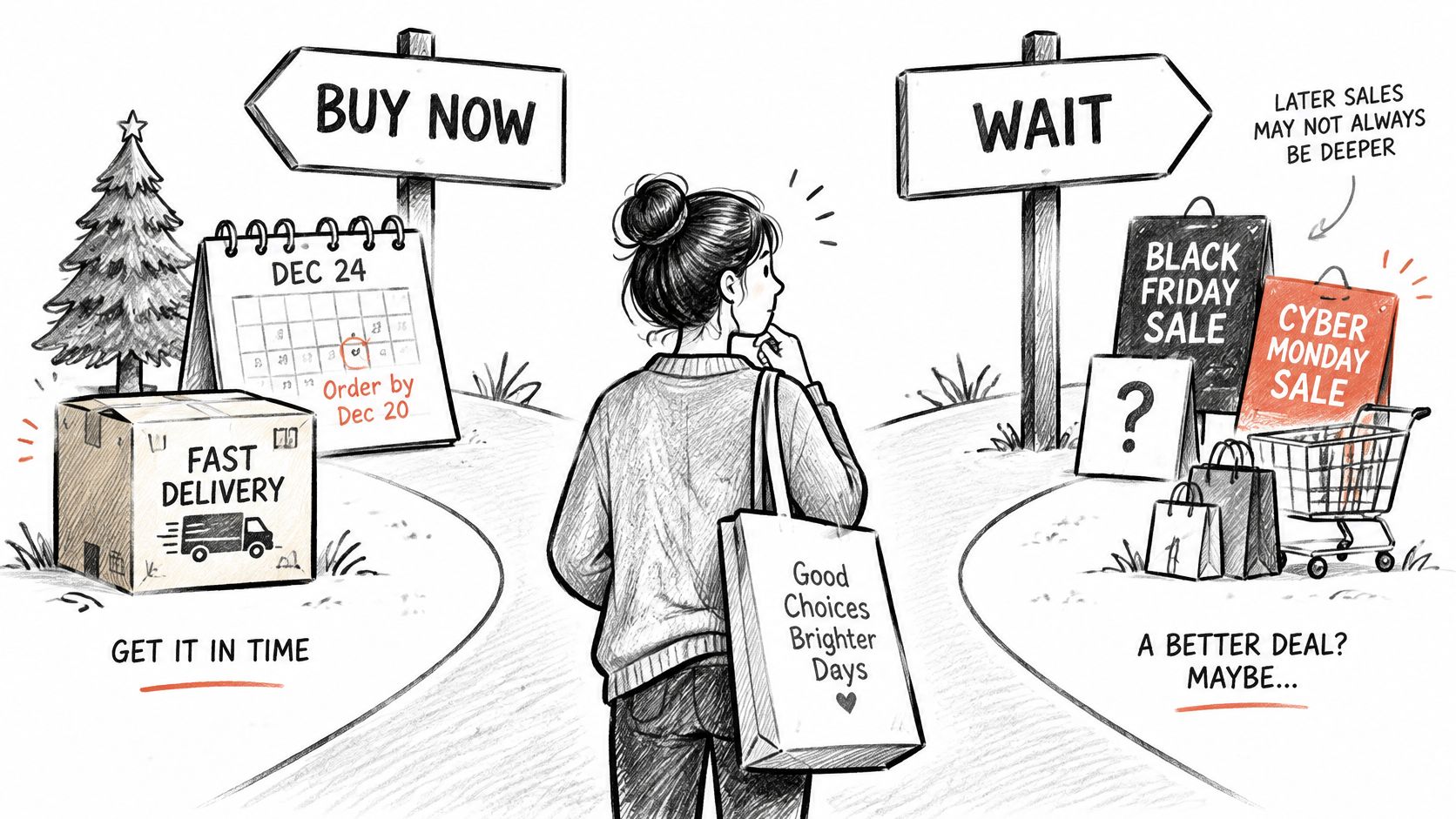
Waiting has a cost that never shows up in a discount percentage. A later promotion can land after the delivery window for the holiday closes, or after the size and style you needed is no longer available. A shopper who held a wreath order in November for a bigger December sale could find the last safe shipping date had passed by the time the code appeared. The discount arrived. The wreath didn't.
Seasonal goods make this sharper than electronics or clothing. Orders go out by UPS Ground with tracking, and the arrival date is set by the shipping schedule, not by when a code happens to surface. A code worth 20% off is worth nothing if the wreath can't reach the door before the day you need it.
Three dates to pin down
- Verification date: the day the code was accepted on a regular retail order at checkout.
- Expiry date: the last day the code stays valid, which should appear in the offer terms.
- Last safe order date: the final day you can order and still receive delivery before you need it, which depends on the shipping method and destination.
The decision rules
Order now if the code verified on a regular retail order, the delivered total beats every alternative you've priced, and your delivery window is tight. Three yeses ends the search.
Check again later only if your timing is flexible, say you're reading this in October and decorating in December. Set one reminder for two weeks before the last safe order date. Daily checking buys you nothing.
Skip the code hunt on fundraiser programs and special offers, where coupons aren't accepted. Judge those orders on the program's own pricing, which sits with the other exclusions covered in the savings types above.
Go straight to a quote for bulk orders, corporate gifts, and client gifting. The wholesale application or a direct message to the business returns a real volume number faster than any coupon field, and a larger wreath or one with more dressing carries its own product-page price anyway.
Run every comparison on the delivered total, never the advertised percentage. The UPS Ground schedule, tracking details, and the delivery window are set out in the shipping and delivery policies explained, and that page is where your last safe order date comes from.
Verify the code at checkout. Compare the delivered total across every option you're considering. Write the last safe order date on a sticky note and order before it, whether or not a code shows up.
Rockdale Wreaths makes fresh Maine balsam wreaths on our family farm in Jonesport, and every order ships from Maine with tracking to the 48 contiguous states. If you'd rather spend your time choosing a wreath than chasing a code that expired last week, start with the current products and prices on the site, then compare the delivered total yourself. Visit Rockdale Wreaths to see this season's wreaths, centerpieces, and cemetery decorations.

